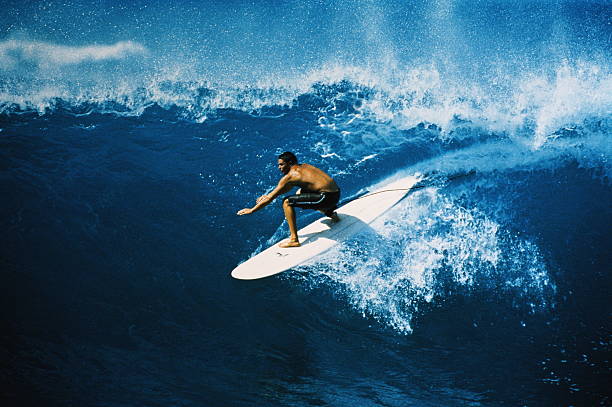
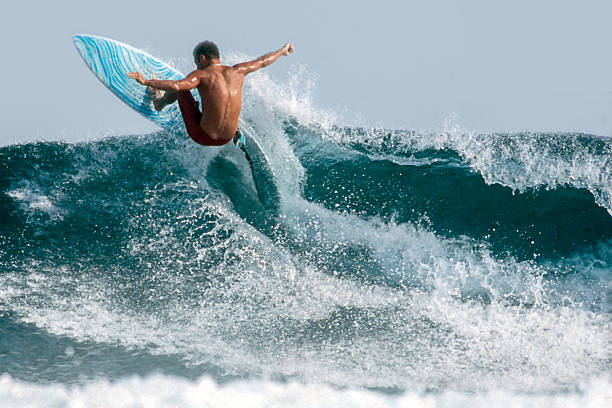
There’s nothing quite like a good point break. The way the swell wraps around the headland, peels down the line with that consistent, roping shoulder, and offers a ride that seems to go forever—it’s the kind of wave that separates casual surfers from those who truly understand the nuances of the ocean. Mastering a point break isn’t just about paddling hard and popping up. It’s about reading the lineup, feeling the rhythm of the swell, and positioning yourself so deep that you can taste the foam ball before it even throws. Let’s paddle out and break it down, brah.
First things first: the foundation of any point break session is the lineup. Unlike a beach break where sandbars shift with every tide, a point break holds its shape based on the offshore reef or rock shelf. That means the takeoff zone is relatively fixed. You want to sit deep, sometimes twenty or thirty yards inside of where the crowd clumps up. Why? Because the best waves at a point break come from the outside swells that have already wrapped around the point, and they’ll jack up faster and steeper the closer you are to the peak. If you’re sitting too far south or too far north, you’ll either get caught inside when a set rolls through or miss the curl entirely. Watch the horizon for a dark line—that’s your set wave. Paddle for it early, with purpose, keeping your eyes fixed on the shoulder as it forms.
When that wave arrives, the takeoff is all about angle. A point break wave often stands up quickly, especially if it’s a long period groundswell. You don’t want to drop straight down into the flats; instead, aim your board slightly toward the pocket. This lets you slide into the critical section with your weight over the rail, ready to make a smooth bottom turn. The bottom turn here is not a hard, abrupt carve like you’d do on a steep beach break barrel. It’s a long, drawn-out arc that follows the face as it sweeps down the point. Keep your eyes on where you want to go—up the face toward the lip—and let your back foot drive the board through the turn. Too much pressure on your front foot and you’ll pearl; too little and you’ll slide out.
Once you’re in the pocket, the real game begins. A point break wave offers long, peeling walls that rarely close out entirely. This is where your flow and wave reading come into play. You need to sense the wave’s energy, anticipating where it will steepen and where it will flatten out. As you race down the line, look ahead. Is there a section that’s about to fold over? That’s your opportunity to do a cutback, wrapping back around the foam ball to stay in the power zone. If the wall opens up, you can throw a big wrap-around re-entry, hitting the lip and coming back down with speed. The key is to never stall for too long in the flats. Keep your momentum by reading the wave’s rhythm—pump down the line, release energy when the face stands up, and load up your turns just as the wave gives you that push.
One of the most underappreciated skills in point break surfing is managing sections. A point break wave often has a “close-out” section halfway down the line, where the reef shallows or the wave bends. You might see a bunch of surfers kicking out there, but the true connoisseur knows how to glide through. You can either fade back onto the foam ball and wait for the reform, or, if you’re feeling spicy, you can pull into a small barrel section that often opens up on the inside. The veterans call this “surfing the whole wave,” and it’s what makes point breaks so rewarding. You don’t just catch one wave; you ride it all the way to the beach, through multiple faces and reformations, like the wave itself is unspooling a story.
Finally, remember that point break surfing is as much about patience as it is about aggression. Some days the sets come every fifteen minutes, and you sit out there watching the horizon, kelp drifting by your fins, the sun warming your back. Use that time to study the swell direction, the wind patterns, and where the other regular-footers are picking off the peaks. When a set finally swings in, you’ll be ready to drop into that snaking right with a calm mind and a loose stance. There’s no rush, no panic—just you, your board, and a wave that seems to have been waiting for you all morning. That’s the stoke of the point break, a dance that never gets old, no matter how many times you ride that same corner.