Most groms think the pop-up is all about speed. They watch the pros on YouTube, see a blur of motion from belly to feet in a single explosive heartbeat, and they think the secret is just getting up faster. But here’s the truth that nobody tells you on the beach: the pop-up isn’t a race against time. It’s a conversation with the wave. And if you’re just hurling yourself upright like a seal escaping a shark, you’re missing the whole point.
Let’s break it down. The number one mistake I see from intermediate surfers is an arched back during the pop-up. They push off the board with their arms, their hips sink toward the tail, and their chest rises to the sky like they’re offering themselves to Poseidon himself. This is what the old salts call the “soul arch,“ and it’s the fastest way to lose your rail and slide right out the back of the wave. What’s actually happening is that by arching your back, you’re shifting your center of gravity toward your heels and the tail of the board. The fins lose their bite, the nose wants to pearl, and suddenly you’re fighting a battle you never needed to fight.
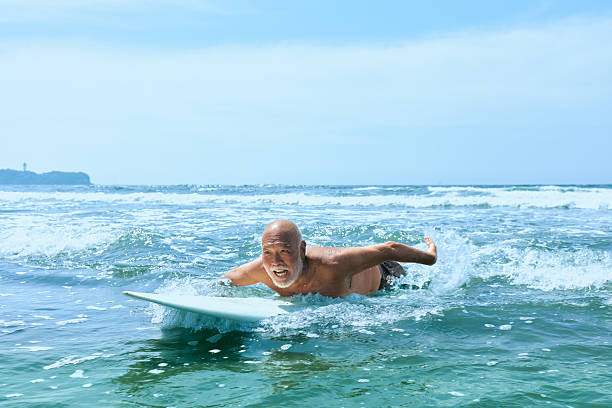
The real key to pop-up perfection is keeping your chest low and your eyes up. Sounds contradictory, right? But think about it like a cat. Watch a cat jump onto a table. The head stays level. The spine stays flat. The power comes from the legs and the core, not from heaving the upper body around. When you’re lying on your board, the ideal starting position is what I call “the cobra coil.“ Your hands should be planted right under your shoulders, palms flat, fingers spread wide. Not too far forward, not too far back. Somewhere in the sweet spot where your sternum feels like it’s hovering just a hair above the deck. Your feet should be together, toes pointed, with the tops of your feet resting against the board. This is where the wave finds you, not where you fight it.
When you feel the wave lift your tail and the acceleration hits, resist every instinct to look at your board. Look where you want to go. That’s the golden rule of surfing and it starts before your feet even touch the wax. If you look down at your feet during the pop-up, your shoulders follow your eyes, your hips follow your shoulders, and suddenly you’re looking at the water you just paddled over. Instead, keep your chin up and your gaze locked on your line down the face. Your body will follow your head like a dog on a leash.
Now here’s the part that changes everything: compress before you pop. The hardest thing to learn is that the pop-up is not a jump. It’s a transfer of energy. When you push off the board, you want to drive your back knee forward and up, not sideways. That knee should come up to your chest like you’re doing a tuck at the bottom of a skate ramp. Your back foot lands directly in the spot where your knee just was. Your front foot slides forward into position, but it doesn’t stomp. It lands soft, with the knee bent, ready to absorb whatever the wave throws at you.
The most underrated drill for this is the “towel pop.“ Take a towel, fold it to mimic the width of your board, and practice the motion on dry land a hundred times a day. But here’s the catch: do it in slow motion. Feel every part of the transition. Feel your hands press, your knee drive, your back foot land. The muscle memory you build at slow speed is the muscle memory that will save you when the wave is pitching and your brain is screaming. Speed comes from efficiency, not from rushing.
And don’t forget your non-dominant side. Most surfers can pop up to their left foot forward because they’ve done it a million times. But the wave doesn’t care about your comfort zone. If you can only go one direction, you’re only surfing half the wave. Spend an entire session forcing yourself to pop up to the other side. You’ll feel like a kook for an hour, but by the end of the session, you’ll have doubled your wave count for the rest of your life.
The final piece is the breathe. Your first pop-up should happen on the exhale. A hard, sharp breath out as your hands hit the deck. This engages your core automatically, drops your chest, and keeps your spine neutral. Inhale when you’re up and riding. Exhale during the explosive part. It’s a small thing, but it’s the difference between feeling like you’re fighting the wave and feeling like you’re flowing with it.
When you nail it, the pop-up doesn’t feel like work. It feels like the wave itself is lifting you to your feet. Your knees absorb the first impact, the board planes out, and the world tilts sideways into that perfect angle. That moment, right there, is why we paddle out on flat days and struggle through washing machine wipeouts. Because when the pop-up finally clicks, it’s not a technique anymore. It’s pure stoke from the inside out.