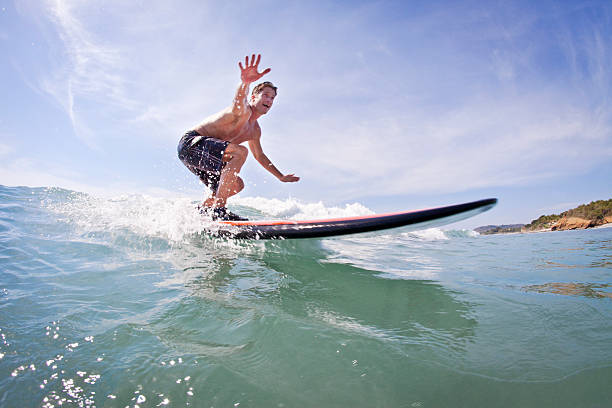
You paddle hard, feel the wave lift your tail, and your body knows it’s go time. That split second when your hands leave the board and your feet search for the deck is the most critical moment in all of surfing. We call it the snapshot. It is the freeze frame between paddling and riding, the instant where your center of gravity either finds its sweet spot or sends you tumbling into the whitewash. And let me tell you, this is where most surfers, from groms to seasoned rippers, lose their stoke.
When you watch a truly smooth surfer, you can see their pop-up is not an explosion of chaotic limbs. It is a controlled, singular motion. The arms and legs move together as one unit. The feet land exactly where the hands just were. This is not luck. This is muscle memory built on understanding the physics of your own body on a surfboard.
The old school taught us to put our hands flat by our pecs and push the whole upper body up, arching the back like a cobra before swinging the legs through. That worked for big, heavy logs, but modern shortboarding requires a different flow. Your hands need to be lower, closer to your hips, almost at your waistline. This changes the angle of your push. Instead of pushing your chest up, you are pushing your hips forward, which naturally brings your feet underneath your center mass. Do not think of it as standing up. Think of it as pulling the board underneath you. The board does not stay still while you climb onto it. You are bringing the board to the bottom of your feet.
The real secret sauce in the snapshot is your head. Your head is a ten-pound bowling ball. Where it goes, your body follows. If you look down at your feet as you pop up, your shoulders will hunch, your hips will drop back, and you will either stall the board or pearly straight into the wave face. Instead, your eyes should already be locked on the section of the wave you want to hit. As you compress into that final paddle stroke, swivel your head and spot your line. The rest of your body will instinctively organize itself to follow that gaze. The surfer who looks at their nose is always going to eat it.
Your back foot is the anchor. It needs to land first. Ideally, it hits the stringer right where your back hand was resting. This puts you in a powerful, balanced stance from the jump. Your front foot should land almost simultaneously, but slightly lighter, ready to pivot. If you land front foot heavy, you drive the nose underwater. If you land back foot too far back, you lose all drive and the wave leaves you behind.
There is a classic mistake I see every dawn patrol. The dreaded praying mantis. Surfers who pop up with their chest still parallel to the deck and their arms splayed out like they are about to fly. This comes from rushing. You cannot rush the snapshot. You have to let the wave pick you up before you commit. Paddle with long, deep strokes until you feel the wave lift your tail. Only then, when you feel that surge of acceleration, do you place your hands and go. Early pop-ups kill your speed. Late pop-ups leave you in the foam ball.
Think about your feet. The moment they land, your knees must bend. I see so many surfers stand up with straight legs, stiff as a board, and immediately get bucked off. The wave wants you to be supple. It wants you to absorb its energy. Your knees are your suspension system. If you land with soft knees, you will find that perfect trim instantly. You will feel the board lock into the face.
One drill that changed my entire surfing life involves dry land practice with your eyes closed. Stand on your board in the sand. Close your eyes. Visualize the wave. Drop down and paddle. Pop up. The split second of disorientation when you close your eyes forces your body to rely on feel rather than sight. It trains your vestibular system to find center without visual crutches. Do this fifty times a day for a week, and your snapshot will become automatic.
When you finally get it right, that moment when your feet land perfectly and the board planes out under you, you will feel a quiet hum of control. You are not fighting the wave. You are in conversation with it. The pop-up is not about getting to your feet. It is about arriving on the wave already in balance, already flowing, already part of the ocean’s rhythm. That is the endless summer of the mind. That is perfection.