There’s a moment when you’re sitting out the back, just outside the impact zone, and the swell pushes up a slab of ocean that looks like it was carved by a mad god. Your eyes lock onto the peak, the way it starts to feather, that little wind-torn curl at the top, and you know—this one’s got the goods. But how do you even start to put words to it? In the lineup, we’ve got a whole lexicon for describing epic waves, and it’s more than just talk. It’s a way to share the stoke, to call out the score, and to remember the rides that change your life.
First off, you got your basic wave shapes. A perfect wave might be called “crystal-clean” face, but that’s just the surface. The real magic is in the hollow factor. When a wave rears up and throws out a thick, roundy lip that pitches out like a balcony, you’re looking at a barrel machine. Surfers will say the wave is “sucking out” or “gobbling up” the water in front of it, creating that green room—the sacred space inside the curl. That’s where the real descriptions come alive. Take the term “hollow.” A hollow wave is one that pitches out so far that the lip lands in front of the wave, leaving a cavern underneath. It demands respect. Then you have “bowly”—that’s when the wave wraps around the reef or sandbar, shaping a concave face that curls like a perfect kidney. A bowly wave will hold you inside, pushing you along the wall as if you’re on a rail. If it’s really deep and dry, you might hear someone yell “pitted!” That’s the ultimate nod—you made it through the barrel and came out the other side with your board still under your feet.
Then there’s “macking.” A macking wave is big, powerful, and it’s not messing around. It’s the kind of wave that makes you paddle early, heart pounding, as the whole ocean seems to unload behind you. A macking wave has walled-up sections that could close out in a heartbeat, but if you’re lucky, it’ll have a re-entry section where you can hit the lip and blow a turn. “Charging” is what you do on a macking day. You don’t just surf a macking wave—you charge it. Other key descriptors involve the wave’s “line.” The line is the path of clean unbroken face that you ride. A “crisp” line means the wave is steep and fast, with no bumps or chop. “Clean” is similar but speaks to the overall condition—no wind slop, no cross-swell interference. “Glass-off” is the dream—when the wind dies and the ocean turns to smooth, translucent glass. A glass-off session gives you waves that reflect the sky, making every drop feel like you’re falling into a mirror.
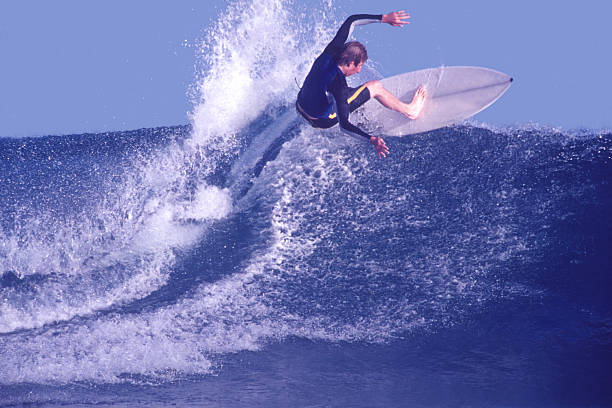
When a wave is breaking cleanly from left to right or vice versa, we call that a “peeling” wave. It peels like the skin off an orange, a clean, continuous curl that allows a long ride. If it peels and then suddenly “sections,” meaning it throws out in multiple parts, you have to make sure to get around the “shut down” or risk a wipeout. A “close-out” is when the whole wave breaks at once—no barrel, no wall, just a violent explosion of foam. That’s a wave you want to avoid, unless you’re a bodyboarder looking for a hard thrashing. But describing epic waves isn’t just about physical properties; it’s about the feeling. A head-high wave might be fun, but a double-overhead set with a “bomb” on the horizon gets the adrenaline going. “Bomb” is that one massive wave in a set that dwarfs the others. When you see a bomb coming, you either paddle hard to get over it or you spin and go—if you’re brave enough. That’s when you’re dropping in on a monster, feeling the acceleration as you slide down the face, the lip reaching out like a claw overhead.
The language also captures how a wave interacts with the elements. “Offshore wind” is when the wind blows from land out to sea, holding up the wave’s face and allowing it to barrel longer. That’s the ideal. “Onshore” wind, on the other hand, chops up the face and makes the wave crumble—nobody wants that. A “sideshore” wind can give you a little bit of both, depending on the angle. Then there’s the swell period, the energy between sets. A long period swell will produce waves that are more organized, with a thick, powerful face that holds its shape all the way through. Those are the waves that carve canyons into the reef, the ones that make you feel like you’re sliding down a waterfall. Short period swells are choppier, less defined, and they fizzle out before you can really get a good ride. The true connoisseur knows the difference just by watching the horizon.
Finally, there’s the spiritual side. The best waves are not just described—they are remembered. A wave that gives you a ten-second tube ride, where you’re staring at the back of the wave with the light glowing through the water, is a magic carpet ride. You might come out shaking, yelling “ohhh!” and gasping for air. The term “teelay” or “delayed” applies when you’re so deep in the barrel that you have to wait an extra moment before making your exit. If you make it, you’re a hero. If you don’t, you get sucked over the falls, rag-dolled by the power of the ocean. So next time you’re in the lineup and someone yells “this thing is so gnarly!” you’ll know exactly what they mean. It’s a wave that has shape, power, and a story to tell. Whether it’s hollow, bowly, macking, or just a clean glassy left—the words we use are the bridge between the ocean and our souls. And that’s the real stoke.