You paddle in, feel that familiar lift as the wave catches the tail, and pop to your feet. But right here, in this split second, everything that follows hinges on one single move. The bottom turn. It’s the corner stone of the entire surf action dictionary, the move that links the drop to the cutback, the floater, the roundhouse, and finally, the air. Without a solid bottom turn, you’re just a guy standing on a board, sliding sideways. With one, you become part of the wave’s energy, a conductor of its raw power.
Picture it like this. Every wave has a face, a steep, moving wall of water. When you drop in, gravity is pulling you straight down the line. The bottom turn is your first real conversation with the wave. You’re not just riding it; you’re telling it, “Okay, I’m here, now let’s get to work.“ You compress your body, sink your weight into your heels or toes depending on your stance, and drive the rail of your board into the water. This rail engagement is everything. That thin fiberglass edge biting into the face creates the friction and pivot point you need to redirect your momentum from straight down to across the line.
A proper bottom turn has a rhythm to it. A sweep. You’ll see the real watermen, the ones who seem to have a telepathic connection with the ocean, doing it with a smooth, unhurried grace. They look like they’re dancing with the wave, not fighting it. Their eyes are locked on the section ahead, already planning their next move before the current one is finished. That’s the difference between a mechanical turn and a piece of surf art. You want to feel the g-force press through your legs, that sweet spot where the board hums against the water, and you’re loading up tension like a slingshot. That tension is your stored energy, ready to be unleashed as you pivot off the bottom and climb vertically toward the lip.
There are flavors to this action, each suited for a different kind of wave or a different kind of maneuver. On a fat, mushy day, you might do a more drawn-out, sweeping bottom turn, keeping your board on a longer, more gradual arc to maintain speed through the flat sections. On a steep, hollow reef break, you need a quick, snappy, almost violent bottom turn, a tight pivot that keeps you in the pocket, right in the barrel’s throat, before the lip pitches over your head. This is sometimes called a “hook” or a “wrap,“ where the turn is so tight that you’re practically reversing direction, wrapping the board around the base of the wave.
Think about it in terms of your feet. Your back foot does the steering, driving the tail of the board through the water. Your front foot controls the trim, the angle of the board, and the amount of pressure on the rail. Getting this weight distribution wrong is a classic newbie mistake. Too much weight on the back foot, and the board will slide out, spinning you out into the foam. Too much weight on the front foot, and you’ll bury the nose, pearling like a submarine. The perfect bottom turn is a dynamic balance, a constant shifting of pressure that feels intuitive after enough sessions.
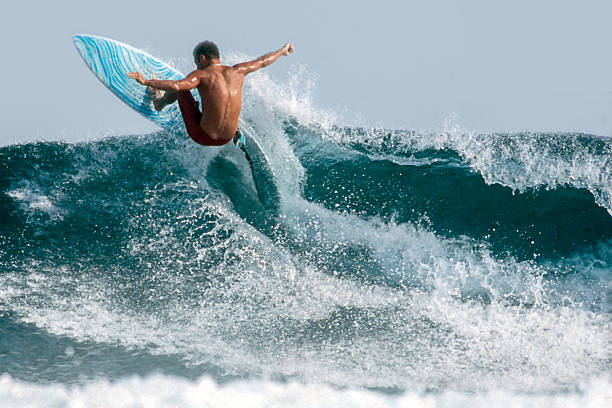
And here’s the real beauty of it. Every single glory move in the surf lexicon flows from this one foundational action. Want to do an aerial? You need a powerful, vertical bottom turn to generate the speed and projection to launch off the lip. Want to pull into a barrel? That bottom turn sets your line, putting you deep inside the green room. Want to perform a smooth cutback and return to the power source? You guessed it. The bottom turn is the pivot point. It’s the A to Z, the alpha to omega of wave riding.
In the end, the bottom turn is more than a technique. It’s a mindset. It’s the moment you stop being a passenger and become a driver. It’s the feeling of compression and release, of surrender and control, all happening in a single, fluid motion. When you nail that bottom turn, you’re not just turning. You’re breathing with the ocean. You’re finding the line. And that line, my friend, is where the endless summer truly lives.