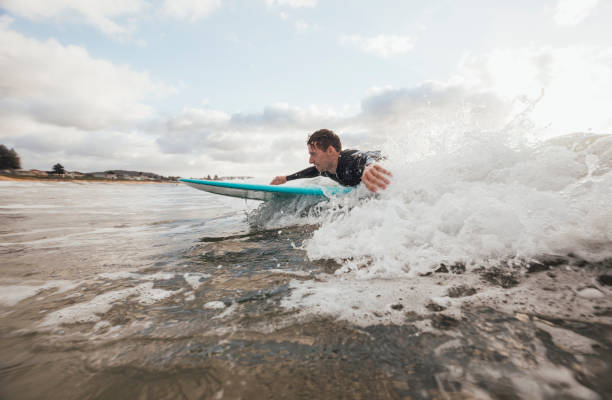
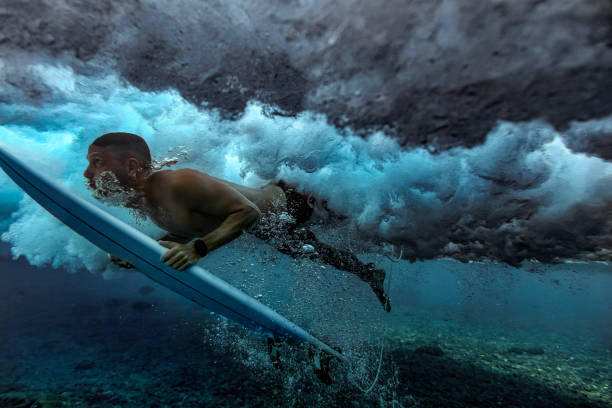
There’s a moment that every surfer knows too well. You’re sitting in the lineup, shoulders bobbing, board pointed seaward, and you see it swing on the horizon. A set. Not just a wave, but a wall of ocean with bad intentions. The first wave rears up on the outside and you feel that little pulse in your chest, the one that says it’s time to commit. You paddle. Hard. A few strokes, then the lip pitches. You grab your rails, push the nose down, sink a knee into the deck, and drive that board beneath the surface like you’re trying to plant a flag in the sand. The whitewater roars overhead. Your ears fill with the rumble of ten thousand tiny bubbles. And for a second, you’re in the quiet blue, holding your board down while the ocean tries to tear it away. That’s the duck dive. And it’s not just a maneuver, it’s a meditation, a negotiation, a little act of trust between you and the wave.
Here’s the thing about duck diving that most beginners get backwards. It isn’t about strength. It’s about timing. You can be built like a heavyweight and still get washed halfway to the beach if you jam the nose down too early or let the board slip out of your hands at the wrong moment. The ocean doesn’t care how much you bench. It cares about whether you understand the rhythm of the wave. When you watch a veteran surfer glide straight through a big set without losing ground, you’re not watching power, you’re watching feel. They see the wave’s shape, feel the swell lift under their chest, and know the exact second to push. It’s the difference between fighting the ocean and dancing with it.
The mechanics matter, sure. You want to start with your hands at the rails, roughly shoulder width apart, and your weight pressing down through the center of the board. The nose goes under first, then your knee drops onto the deck, and you push the tail down with your back foot or your shin as the wave meets you. That sequence creates the perfect angle, so the board slices beneath the foam instead of getting caught flat and ripped from your hands. But the real magic happens in the timing. If you push too early, the board pops back to the surface like a cork and the whitewater grabs it like a flying disc. If you push too late, the lip is already on top of you and you’re just getting sucked into the washing machine. The sweet spot is that half-second when the wave is about to break, when the water is still moving upward but the foam hasn’t yet exploded. That’s the window.
And here’s where it gets deeper. Duck diving is a practice in letting go. You have to be willing to go under, to embrace the dark and the pressure and the disorientation, because the alternative is getting pounded. That’s true in the water and it’s true in life. You can’t paddle over every problem. Some waves are too big. Some situations demand that you submerge, that you hold your breath and protect what matters, and then rise again on the other side with your board still under your chest. The ocean teaches you that survival isn’t about avoiding the wash, it’s about knowing when to take it clean. Every duck dive is a little lesson in humility. You are not bigger than the wave. You’re just smarter about how you navigate through it.
Different boards change the game, too. On a thick foamie, you’re not duck diving much, you’re just pushing it under and hoping. On a shortboard with a lot of volume, you need to be more deliberate with your knee and your back foot. On a thin, glassy, high-performance stick, you can knife it through the surface like a guillotine. But regardless of what you’re riding, the principle stays the same. You want to keep the board close, keep your body streamlined, and get deep enough that the turbulence passes over you without pulling your fins loose. Some surfers swear by grabbing the nose with one hand and a rail with the other, pulling the nose down while kicking the tail through. Others prefer a more centered push, both hands on the rails, letting the board’s outline do the work. There’s no single right way. There’s just the way that works for your board, your body, and the wave in front of you.
What separates the good duck divers from the great ones is what happens before the push. It’s the positioning. If you’re too far inside, no technique will save you. You need to read the set, see where the peak is going to throw, and paddle to the spot where the wave is steepest but not yet broken. That’s the line. The guys who make it out effortlessly aren’t just duck diving better, they’re reading the ocean better. They know that a wave that’s already broken is a lost cause. They put themselves in the zone where the wave still has a clean face and the whitewater hasn’t formed, and then they drive under with purpose. That’s the whole game. It’s not about brute force. It’s about positioning, timing, and the quiet confidence to go under knowing you’ll come back up.
So next time you’re paddling out and a set looms on the horizon, don’t panic. Breathe. Look at the wave. Feel the pulse of the ocean lift beneath you. And then go under, clean and calm, like a seal slipping into the blue. That’s the endless summer right there, the rhythm of ducking through chaos and rising again, ready for the next one.