Pop-Up Perfection: The Art of Getting to Your Feet

Let’s cut straight to the chase. In surfing, everything hinges on the pop-up. That single, fluid motion from lying prone to standing tall is the gateway to every turn, cutback, and barrel that follows. Mess this up, and you’re just a passenger on the wave. Nail it, and you’re in the driver’s seat, ready to carve your own line. This isn’t about fancy tricks; it’s about foundational power. It’s the difference between a kook struggling in the whitewater and a surfer setting a line for the shoulder.

Think of it as the most critical take-off in surfing. You’re not just standing up; you’re launching into a dynamic, moving environment. The mechanics are simple, but executing them under pressure—with the lip pitching behind you and the reef or sand below—is where the art lies. It starts on dry land. Practice on your living room floor until the motion is muscle memory. Position your hands flat on the board, directly under your chest. Your back is arched, head up, eyes forward—you’re a coiled spring, not a limp noodle.

When the wave lifts you, it’s go-time. This isn’t a slow, thoughtful push-up. It’s an explosive, single-action snap. In one motion, you push your upper body up while simultaneously swinging your back foot underneath you, planting it flat on the deck. Don’t place it too far forward or back; aim for the center of the board, perpendicular to the stringer. This is your anchor. Your front foot then follows in a smooth arc, landing somewhere between your hands, which are now coming off the deck. The key? Your back foot hits first. Always. This stabilizes the board instantly. A common kook move is bringing both feet up at once or leading with the front foot, which sends the nose diving or has you wobbling like a newborn giraffe.

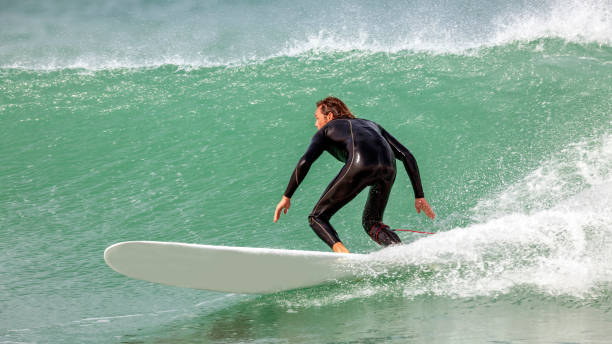
Your stance is everything once you’re up. You want a low center of gravity, knees bent, back straight. Your feet should be roughly shoulder-width apart, angled slightly across the board—this is your natural surfing stance, regular or goofy. Your arms aren’t for balance; they’re for steering and flow. Point where you want to go. Look down the line, not at your feet. Your body will follow your gaze. This initial stance sets your rail and dictates your first bottom turn. Get it wrong, and you’ll either pearl straight into the drink or slide out the back because you’re too stiff.

The pop-up’s perfection is judged by its efficiency and adaptability. On a fat, mushy day, you might have time for a slightly more drawn-out, casual stand. But when it’s pumping overhead and hollow, your pop-up needs to be a lightning-fast, committed thrust. There’s no second-guessing. You explode up and immediately engage your rail, projecting your weight forward to match the speed of the wave. It’s this connection between the pop-up and the first turn that separates the weekend warrior from the true surfer.

So, forget the advanced maneuvers for a minute. Go back to the basics. Drill that pop-up on the beach until it’s second nature. Because out in the lineup, when that set wave you’ve been waiting for finally swings your way, you won’t have time to think. You’ll just react. And a perfect, no-nonsense pop-up is the only thing that gets you out of the turbulence and onto the open face, ready to chase down that endless summer feeling, one flawless take-off at a time.
Related Posts

Live Surf Cams

Surfline Live is a 24/7 glimpse into the world’s surf.

This stream moves through Surfline's global camera network, showing spots where it’s daylight and rated Fair or better.

What's The Deal With...?

Surf Icons & Heroes

What was Eddie Aikau’s role as a lifeguard?

As the first lifeguard for the entire North Shore of Oahu, stationed at Waimea Bay, Eddie was a true guardian. He worked without a single fatality on his watch, performing countless heroic rescues in the most treacherous conditions. His role cemented his deep connection to the ocean—it wasn’t just about riding waves for fun, but about understanding its power to protect others. This duty honed his wave-reading skills and solidified his reputation as a selfless waterman who lived the meaning of aloha every single day.

How does Layne Beachley give back to the surfing community?

Big time! She runs the Layne Beachley Foundation, focusing on empowering young women through education and surf mentorship. She’s a huge voice for “Aim for the Stars,“ helping girls achieve their dreams. She’s also a passionate ambassador for ocean conservation and mental health awareness, often speaking openly about her own challenges. For her, giving back is part of the soul of surfing—using her platform to create positive ripples far beyond the lineup.

What was Dora’s relationship with the surf industry?

He famously despised it. While others cashed in during the Gidget boom, Dora saw the surf biz as a sell-out, corrupting the pure stoke. He’d reluctantly endorse boards for cash but was notorious for biting the hand that fed him, often criticizing the very companies paying him. This love-hate tension made him a fascinating paradox—a top-tier surfer who openly mocked the professional surfing world, becoming the patron saint for those who believe the core spirit can’t be packaged and sold.

Surf Lingo Explained

Why is it crucial to know how your leash works?

Your leash is your lifeline to your board, which is your biggest flotation device. Knowing how to quickly grab and reel it in after a pounding can get you to the surface faster and save energy. Check the cuff and velcro regularly for wear—a snapped leash in a big swell is a serious situation. Understanding its length also helps you gauge your “wipeout radius” from your stick. It’s simple gear, but treating it right is a major safety fundamental.

What’s the one piece of advice for handling a two-wave hold-down?

Stay calm, if you can. Panic burns oxygen. The first wave is often the worst. As it passes, start swimming for light, but conserve energy. The ocean will usually spit you up for a quick gasp before the next one hits. Use that split second to inhale deeply and get your bearings. Trust that the set will pass. Fighting against the entire ocean’s energy is exhausting and futile; sometimes you just have to let it have its way with you for a moment.

What’s the best way to improve my cutback and link my maneuvers?

To link your turns like a legend, you need flow, not just random hacks at the lip. A powerful cutback starts with a solid bottom turn to generate speed and project you back toward the whitewater. Don’t just look at your board—rotate your head and shoulders to initiate the turn; your board will follow. The magic is in the rebound. As you complete the cutback, aim to hit the pocket of the wave with enough momentum to drive straight into your next bottom turn, setting you up for another section. Think of it as one continuous dance with the wave, not separate moves.