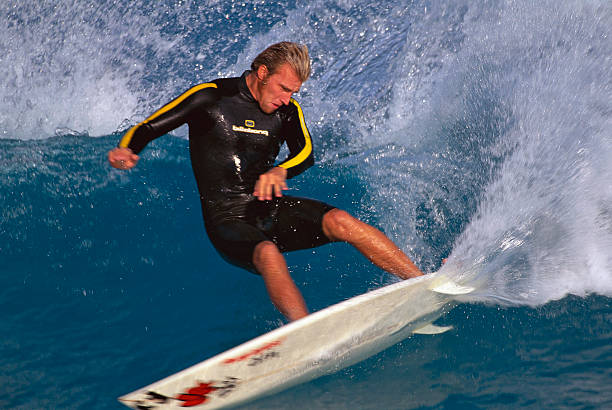
Let’s cut through the froth and get down to the green room of the matter. You can have the latest carbon-fiber wonder-stick and the most stylish boardies, but without solid technique, you’re just a passenger. Moving from kook to competent—and beyond—isn’t about magic; it’s about mastering the fundamentals until they’re as natural as breathing salt air. This is a no-nonsense look at the core techniques that separate the strugglers from the flow-riders.
It all starts on dry land, but the real work begins in the whitewater. Before you even think about dropping in, your pop-up needs to be one fluid, explosive motion. None of that knee-creeping, slow-motion stuff. It’s a single push-up that launches you to your feet in one go. Practice it on the living room floor until it’s muscle memory. Your stance is your foundation: feet shoulder-width apart, knees bent in a low, athletic squat, back straight, arms out for balance. Think of yourself as a spring, coiled and ready, not a stiff statue. This is your neutral, ready position—the platform from which every turn and adjustment flows.
Now, for the moment of truth: the takeoff. Paddling isn’t just arm-churning; it’s about commitment and timing. You need to match the speed of the wave, feel that lift in your tail, and then, in that critical second, go from swimmer to surfer. The pop-up happens as the wave picks you up, not after. Hesitation is your worst enemy here. A late drop sends you down the face, out of control. Too early and you pearl, nosediving straight into the drink. It’s a feel you develop over time, a conversation between you, your board, and the ocean’s energy.
You’re up and riding. Congratulations. Now what? This is where trim comes in. Trimming is the art of weight distribution—shifting your weight slightly forward to gain speed, leaning back to slow down or set a rail. It’s subtle, often just a tilt of the shoulders or a slight bend in the ankles. A board in perfect trim feels like it’s on a magnetic track, gliding effortlessly across the open face. Mastering trim is the first step to true down-the-line speed and flow; it’s how you harness the wave’s power instead of just surviving it.
To truly surf, you need to turn. And the genesis of every turn is the bottom turn. After dropping down the face, you use the bottom of the wave as a ramp to redirect your speed back up towards the pocket. It’s not just a casual lean; you drive your inside rail into the trough, compressing your legs and then extending, using the wave’s shape to project you back up and down the line. A weak bottom turn leaves you behind the section. A powerful, committed bottom turn sets up everything that follows—it’s your launchpad for cutbacks, re-entries, and carving arcs.
Speaking of which, the cutback is your reset button. When you’ve raced too far ahead on the shoulder, you use a cutback to slash your way back to the power source: the pocket. It’s a sweeping, drawn-out turn where you use your eyes, shoulders, and hips to whip the board around, throwing a bit of spray and reconnecting with the energy of the wave. It’s the punctuation in a surfing sentence, a way to maintain your place in the green room and set up for the next maneuver.
Ultimately, advanced surfing is linking these fundamentals together with style and intention. A great surfer makes it look easy because their technique is so ingrained it becomes instinct. They read a section, set a bottom turn, project, hit the lip, recover, and trim with a seamless rhythm that’s pure poetry in motion. So forget the fancy airs for now. Dial in your pop-up, feel your trim, commit to your bottom turns, and learn to reconnect with the cutback. The rest—the tubes, the snaps, the floaters—all stem from this solid core. Get these right, and you’re not just riding waves; you’re starting a real conversation with them. Now get out there and put in the water time.