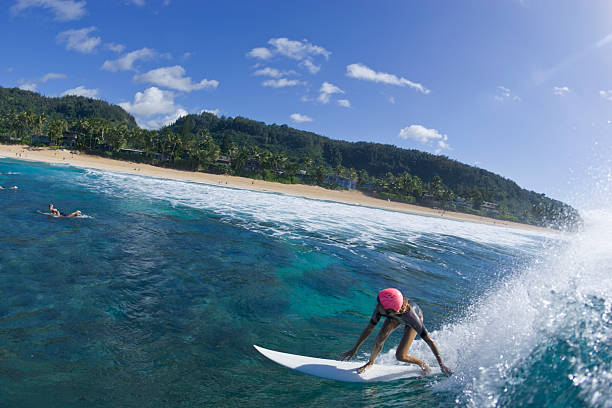
When you paddle out on a crisp morning and the ocean is all cobalt glass, the last thing you think about is your fins. But once you’re up and sliding down the face, feeling that familiar bite or that loose drift, you realize fins are everything. They’re the unsung heroes of your surfboard, calling the shots on every bottom turn, every cutback, every snap off the lip. In the world of surf gear, fin companies are the artisans who shape your ride. Tuning your fins is like tuning a fine guitar – miss the sweet spot and the session goes flat, hit it right and you’re playing melody with the tide.
Let’s talk players. Futures and FCS dominate with massive template libraries. Boutique builders like True Ames, Captain Fin, and Rainbow Fin hand-pour resin and obsess over flex patterns like chefs over a secret sauce. Futures uses a simple grub screw system that lets you swap fins while bobbing in the lineup. FCS perfected their tab system for rock-solid rail pressure. True Ames channels the alaia spirit with retro keels, while Rainbow’s swirling colors come from a layup that gives a unique flex memory. Each company has its own philosophy, but the goal is the same – to make you feel faster, looser, and more connected.
Tuning your ride isn’t about buying the priciest fins. It’s about matching hardware to waves. On a fat summer swell, you want something loose – small keels or a quad with heavy rake. That rake, the backward sweep, gives you a pivoty feel, perfect for slow, crumbly faces. For thumping barrels, go with drive and hold, like a thruster with a large center fin that locks you in. When it’s overhead and you want to lay into a massive carve, tune your foil. A convex outer face gives lift and speed, while a flat foil releases snappily off the top. The right fin set makes a mushy wave feel hollow and a scary wave feel playful.
The real magic, though, lives in cant and toe. Cant is the fin’s angle relative to vertical. More cant leans the fins outward, creating a skatey, loose feel but sacrificing some drive. Toe is the inward angle at the front. A little toe helps you turn tighter, but too much and the board starts fighting you, shoving your back foot around. Most fins come with fixed angles, but high-end sets let you adjust them on the fly. That’s where true tuning begins – you’re customizing for your stance, your weight, and the break’s particular character. It’s the difference between riding a board that works and riding a board that sings.
Flex is the next frontier. A stiff fin delivers raw power and immediate response, but it can beat you up in choppy conditions. A flexy fin absorbs the bumps and feels silky smooth, yet too soft and you lose your snap in critical sections. For decades, companies have experimented with layups. A honeycomb core wrapped in fiberglass hits that sweet spot – enough rigidity to hold a rail through a turn, enough give to release when you need it. Bamboo and wooden fins offer a different memory altogether, supple and organic, with a spring-back that many old-school loggers swear by. Don’t underestimate the personality of materials.
The most common mistake is sticking with the same fins season after season. The ocean changes, your board changes, your surfing changes. On a groveler, rock a tiny twin keel for knee-high mush. On a step-up, run a beefy thruster to push through heavy water. On a longboard, a classic 50/50 flex fin lets you trim and cross-step without wobble. Modern fin systems make swapping easy, so there’s no excuse not to experiment. That’s the endless summer spirit – always chasing the perfect ride, and fins are your most direct connection to that chase.
So next time you’re waxing up in the parking lot, give your fins a thought. Feel the slots, check for loose screws, maybe borrow a different set from a buddy. Tuning your ride is a conversation with the ocean. Listen to what the waves are telling you, and your fins will translate that into pure stoke. Shred on, and may your rails never slip.