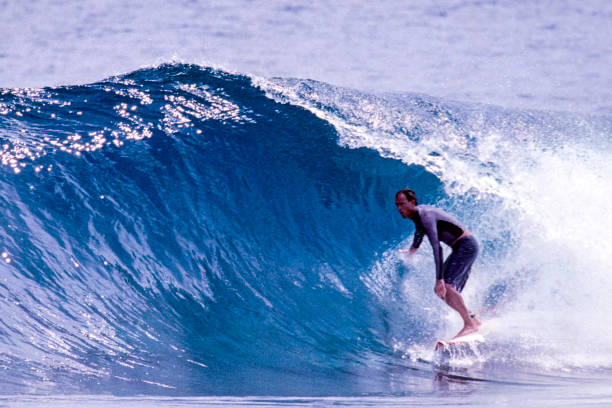
There’s something primal about paddling out at a reef break. You feel it before you see it—that low, rumbling pulse of water moving over submerged rock, a heartbeat that’s been pounding for eons. Unlike the sandy shuffle of a beach break or the mellow, wrapping perfection of a point, a reef break is a negotiation between the ocean and the earth, a conversation that happens right beneath your board. And when you drop into one, you’re not just riding a wave. You’re riding the raw, unedited language of the sea, translated through a crusty old limestone shelf that doesn’t care how many tubes you’ve logged.
Let’s break it down. A reef break forms when swell rolls across a rocky bottom—coral, lava rock, limestone, even scattered boulders—that sudden shallowing jacks the wave up from deep water into a steep, grinding wall. That’s why reef waves have that notorious, hollow lip. The reef acts like a ramp, focusing all that energy into a tight, critical section. No forgiving sandbars shifting with every tide, no soft shoulders to bail on. Just a razor-thin line between a perfect barrel and a shallow, unforgiving meeting with geology.
The magic of reef breaks lies in their consistency. Because the reef is fixed, the wave breaks in the same spot every single time, given the right swell direction and tide. That consistency is a gift and a curse. It lets you study the lineup like a map, memorizing the takeoff zone, the channel, the sneaky shallow spot that only shows at low tide. But it also means the ocean doesn’t give you any slack. That one rock you saw at low tide is still there when the water fills in, hiding three feet under the surface, waiting for you to get too cocky on a late drop.
Every reef has its own personality. There are sleepy, slow-rolling reef breaks that cradle you from the first pump to the final kick-out, gentle reefs that feel like a friendly old dog. Then there are heavy slabs—the Tunnels, the Chopes, the Pipe of the world—where the reef drops off dramatically and the wave detonates in less than a second. Those are the breaks that earn their fear. The bottom is littered with brain corals and jagged outcrops, and the locals paddle with a quiet intensity that says, “You’re a guest here, and the reef doesn’t check guestbooks.”
What makes reef breaks so special for the surfer is the line they carve on the face. A good reef wave has a defined racetrack, a groove that the water follows every cycle. You can hit the same section with full commitment, knowing the wave will hold its shape. That’s why so many high-performance maneuvers—the deep tube, the snap off the foam—happen on reef breaks. The wave gives you an exact canvas, and if you make a mistake, it dings your board and your ego in equal measure.
But let’s talk respect. And that’s not some cliché surfer gatekeeping. It’s about acknowledging that reef breaks are wild, unfiltered forces. The tide can shift your whole world in forty minutes. A channel that was deep at dawn becomes a bone-jarring shelf by lunch. The swell can double overnight, turning a fun right into a runaway freight train. You have to check the charts, ask the locals, bring extra fins, and swallow your pride when the reef says “not today.” Learning to read the water color—the dark patches that mean shallow coral, the light-green shimmer that means a sandy patch between rocks—is an art form. Surfers who master it are the ones who walk away with stories, not stitches.
There’s also a certain stoke to surfing a reef alone at first light. The surface is glassy, the air smells like salt and iodine, and the only sound is the hiss of your fins cutting water. You paddle out along the channel, give the lineup a respectful nod, and wait. Then you see the bump on the horizon. It swells, steepens, and the reef below you groans. You pivot, stroke hard, and drop in. The takeoff is steep, almost vertical, and for one pure second you’re suspended between water, wind, and rock. Then the wave pitches over your head, and the world becomes turquoise and thunder. That’s reef surfing. Not just a wave, but a pact you make with the ocean—you give it your full attention, and it gives you a moment of absolute clarity.
In the end, reef breaks teach humility. They remind you that no amount of fancy gear or big-wave bravado can buy passage. You earn it. You learn the tides, the swells, the hidden dangers. You respect the locals, not because they’re gatekeepers, but because they’ve paid their dues in coral cuts and broken boards. And when you finally get that barrel—that clean, square, spit-filled tube—you know it wasn’t luck. It was a conversation between you, the ocean, and that ancient stage of stone. So next time you paddle out at a reef, take a breath. Feel the pulse below you. And listen. The reef has a lot to say.