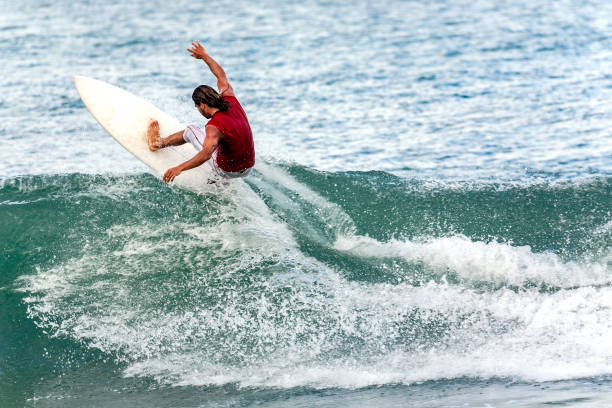
You ever watch a guy on a shortboard scratch into a wave when everyone else is sitting deep, looking like a seal trying to climb a greased up ladder? He gets pitched over the falls and you just shrug. Then your buddy, the one with the overgrown log, glides into the same set from the worst position on the sandbar, paddles twice, and rides it to the inside. You wonder what the hell his secret is. It ain’t magic and it ain’t luck. It’s the quiet king of surfboard evolution nobody talks about enough: volume.
For decades the old guard got hung up on length. You ride a 9’0”, you’re a kook on a log. You ride a 6’0”, you’re a shredder. Simple as that. But board designers figured out that a 6’4” with a ton of thickness and a wide outline paddles just as easy as your dad’s old longboard, while still letting you drop in vertical. That changed everything. The real game now is understanding liters, which is just a fancy way of saying how much foam you have under your chest. It’s the difference between feeling like you’re on a cork or a brick.
Here is the thing nobody tells you at the shop. A board that is too small will ruin your wave count faster than a choppy south swell. You spend half the session taking off late, paddling like a maniac, and watching the wave suck over your tail. That isn’t a skill issue. It is a volume issue. You don’t have enough float to match your body weight, your skill level, and the wave power at your local break. If you push a 5’10” fish that only holds 25 liters and you weigh 180 pounds with a wet suit, you are going to have a bad time. You need enough buoyancy to support you while you’re lying flat, not just while you’re standing up.
Think about it like floating a log in a river. A skinny stick sinks low, catches every current, and takes a ton of effort to steer. A fat log sits high, glides over the bumps, and responds to a single paddle stroke. That’s the difference between a low volume board and a high volume board when you are trying to catch a wave. You want the board to do the heavy lifting so you can focus on the drop, not the burpee workout.
But here comes the tricky part. Too much volume can be just as cursed as too little. You see guys on 40 liter thrusters that look like school busses under their feet. They paddle easy enough, but the board sits so high in the water that it feels disconnected. You lean for a bottom turn and the rail grabs at the last second, throwing you off balance. The board bounces around in the chop like a fat kid on a trampoline. That’s because you’ve got too much foam fighting against the water’s surface. You don’t get the same engaged, locked-in feeling you need for critical sections. Volume is a tool, not a trophy.
The evolution of the shortboard tells the story best. In the 70s and 80s, boards were thick, full rails, and heavy. They floated like boats but turned like whales. Then the 90s brought the thin, super narrow, pinched rail boards. Those were fast and responsive, but you needed a paddle crew to get into anything smaller than double overhead. Now the modern hybrids and step-ups use strategically placed volume. You see boards with beefed up chest areas, thinned out tails, and pulled in noses. You get the paddle power where you need it, and the release where you want it. That is the sweet spot.
For the everyday surfer chasing that Endless Summer feel, volume should be your first conversation, not your last. If you are frustrated and not catching waves, add 5 to 10 liters to your next board. If you feel like you are riding a barge and can’t turn, take 5 liters off. There is no perfect formula because your weight fluctuates, the wind shifts, and every break has its own personality. A beach break with steep dumpers wants less volume than a mellow point break that needs paddle glide. But the rule of thumb is simple. If you are not having fun, the volume is wrong.
Listen, board evolution has given us more options than ever. You don’t have to be stuck on a board that fights you every session. Go demo a few shapes with different liters. Feel how a few extra pounds of foam changes your timing, your pop up, and your wave count. You might find that the board you thought was too big is actually the key to unlocking a whole new level of relaxed, stoked surfing. And isn’t that the whole point?