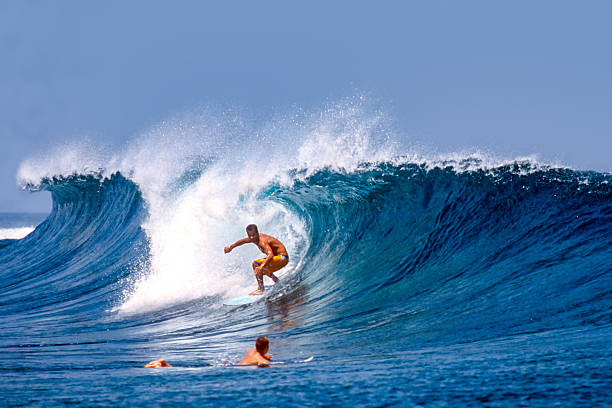
You paddle out past the shorebreak, through the whitewater soup line, and finally feel that familiar exhale as you settle into the lineup. The ocean is glassy, the sets are rolling in with that deep, turquoise pulse that makes your heart thump a little harder. You see a peak feathering on the horizon, and your instincts kick in. But before you spin around and start stroking, there is something you gotta remind yourself of, something that separates a seasoned waterman from a kook on a rental log.
It is the unspoken law of the drop-in. And it runs deeper than any rulebook.
We all know the basics. First one on the peak gets the wave. Paddle wide around the inside. Don’t snake your buddy. But what happens when the lineup gets crowded, when egos swell like the afternoon trade winds, and you see that one wave peeling down the line with your name on it—and someone else’s name, too? That is the moment where surf etiquette stops being a list of do’s and don’ts and becomes a pure reflection of character.
Let’s talk about the drop-in. Not the accidental one where you misread the section. Not the one where you didn’t see the guy paddling behind you. I’m talking about the intentional drop-in, the one where a surfer, knowing full well someone is already riding, decides to take the wave anyway. You see it happen at every crowded break from Malibu to Mundaka. A guy paddles for a wave, stands up, and then some other fella, usually with a brand new board and a chip on his shoulder, launches himself off the shoulder, right into the path of the rider. It is a dangerous, selfish move that can snap a leash, crack a rail, or worse, send someone into the reef.
But here is the thing about surf etiquette that most beginners don’t get. It isn’t about being polite on the surface. It’s about survival. When you drop in on someone, you are disrespecting the subtle order that keeps a lineup from turning into a fistfight. You are telling every other surfer out there that you don’t care about their safety, their stoke, or the simple fact that they caught that wave fair and square. You are burning the karma that keeps the ocean happy.
The real surfers, the ones who have been doing this for decades, know that patience is the ultimate power move. They watch the set waves roll through, maybe letting two or three go to a local who has been sitting in the right spot, waiting their turn. They know that the wave you miss is not the only wave. There will always be another peak, another pulse from the deep. And when you give respect to the lineup, the lineup gives respect back. You get better waves because you are not in a constant battle. You are part of the rhythm.
There is a deeper layer too, one that touches on the essence of why we paddle out in the first place. Surfing is supposed to be a break from the noise, a reset. When you bring the same dog-eat-dog attitude from the parking lot into the water, you are missing the point. The lineup is a community. It is a shared space where everyone is chasing the same feeling of gliding across a face of energy. When you drop in on someone, you are not just stealing a wave. You are stealing a moment of pure, unadulterated joy.
So next time you see a wave peeling and you feel that urge to paddle, take a second. Look over your shoulder. Acknowledge the surfer already in position. Maybe even give them a nod. Let them take the wave. And then watch them. Watch how they ride. Notice the line they take, the way they set their rail. You will learn more from that one wave of observation than you will from ten waves stolen.
The ocean has a way of humbling everyone. The same swell that gives you a perfect barrel can put you on your back in a heartbeat. Egos have no place in the water. The lineup is a living, breathing code of conduct. You earn your place in it not by taking, but by giving. By waiting your turn. By respecting the drop.
That is the real secret to mastering the waves. It has nothing to do with how many airs you can land or how deep you can get in a tube. It is about showing up, sitting in the saddle, and knowing that a wave shared, or a wave let go, is sometimes worth more than the one you take.