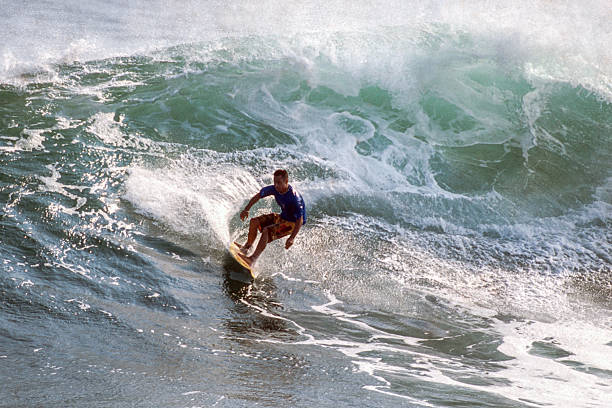
The thing about surfing is, sometimes you chase the perfect barrel, and sometimes you just chase a smile. And there’s no board that puts a grin on your face faster than a Mini-Simmons. This little plank of joy, a true “fun shape” in every sense, is a throwback to the days when Bob Simmons was shaping foam in his garage, asking questions nobody else was thinking about. If you haven’t hopped on one of these wide, flat, twin-fin beauties, you haven’t felt the absolute purest form of glide the ocean can offer.
You see, the original Simmons hull design from the late 1940s and early 1950s was all about speed and displacement. Bob Simmons was a mathematician and an engineer, and he designed boards that would literally ride on a cushion of air, reducing drag. The Mini-Simmons takes that same core idea—that flat, almost plank-like bottom, that wide outline, and those hard, cutaway rails—and shrinks it down into a board that paddles like a longboard but turns like a skateboard on a half-pipe. It’s a modern reinterpretation that surfers like Tom Wegener and Ryan Lovelace brought back from the dead, and the stoke is contagious.
What makes a Mini-Simmons so different from the standard shortboard you see in a WSL heat? Everything. The rocker is practically non-existent. It’s flat as a pancake from nose to tail. That means it catches waves earlier than almost anything else in your quiver. You can paddle in on a ripple that wouldn’t even lift a modern thruster. The width is the next thing that hits you. These boards are wide. Like, really wide. A typical Mini-Simmons for a six-foot surfer will be almost twenty-three or twenty-four inches wide. That’s longboard territory, but in a package that’s often under six feet long. The result is insane buoyancy and stability. You can stand up on this thing like you’re on a dock. But then you turn it, and the magic happens.
That flat bottom and wide outline give the board incredible lift. When you drive off the bottom, the board doesn’t sink; it wants to fly. The hard, 90-degree rails that wrap around the tail, paired with a pair of small, upright twin fins, create a release that is unlike any other. You initiate a turn, the board digs in for a split second, and then it just slides. It’s a drifty, loose, almost skate-like feeling. You’re not carving a deep, vertical line. You’re sliding, pivoting, and spraying water in all directions. The whole vibe changes from “brutal power” to “playful flow.“ It’s surfing on easy mode, but in a way that makes you feel like a creative genius instead of a kook.
Now, the critics will say these boards don’t work in steep, hollow waves. And they’re right. A Mini-Simmons is not your weapon for a ten-foot Pipeline barrel. The lack of rocker and the wide nose make it a handful in a heavy, pitching lip. But that’s missing the point. This is an everyday surfing board. This is for the dawn patrol where the swell is waist-high and the wind is slightly onshore. This is for that afternoon session when the tide is high and mushy. This is the board you grab when you don’t want to fight the ocean, you just want to dance with it. It embodies the “fun shape” ethos perfectly: it prioritizes pure enjoyment over performance metrics. You aren’t chasing the highest score on a heat sheet. You’re chasing that feeling of floating, that endless, effortless glide that reminds you why you fell in love with this sport in the first place.
The soul of the Mini-Simmons is really the soul of the “Endless Summer” lifestyle. It’s about finding stoke in the small stuff. It’s about adapting to the conditions you have, not the conditions you wish you had. On a Mini-Simmons, a one-foot day becomes a playground. You can trim across the face with no effort, throw fins-out slides, and even run up to the nose for a little cross-step action if you feel like it. The board asks almost nothing of you in terms of paddle fitness or wave judgment. It just rewards you with pure, unadulterated speed.
If you are stuck in a rut, riding the same high-performance thruster every day and feeling like the stoke is slipping away, do yourself a favor. Find a local shaper who builds a Mini-Simmons, or grab a like-minded alternative board from a big brand. It doesn’t have to be a perfect replica of a 1950s hull. It just has to be short, wide, and flat. The moment you paddle out, catch that first slow, rolling wave, and feel the board just hum beneath your feet, you’ll get it. The surf gods aren’t always about the biggest wave. Sometimes, they’re just about the purest glide.