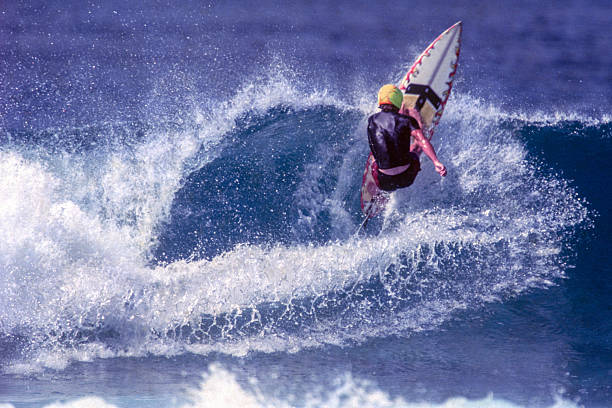
In the pantheon of surfing greats, there are power hitters and aerial assassins, but there is only one Tom Curren. He is the poet of the pocket, the quiet revolutionary who turned surfing from a brute struggle against the ocean into a fluid conversation. While others thrashed and hucked, Curren flowed. His style was not a move set but a whole approach—a way of being in the water that made the most complex waves look like glassy perfection. To watch him surf is to hear a whisper in a world of shouts. And that whisper has echoed for decades, shaping how generations of surfers think about the ride.
The magic of Curren lives in the technical details that somehow feel effortless. Watch any footage from the early eighties, when he first came up on the world stage. His back foot sits on the tail like a quiet anchor, while his front arm trails like a kite string, keeping him loose and ready. When he takes off, he does not snap into the wave; he melts into it. His bottom turn is a drawn-out arc, a patient compression that coils energy deep in the legs. Then, as the wave’s power peaks, he releases it—not with a frantic hack, but with a smooth rail-to-rail transfer that leaves a pencil-thin line of spray hanging in the air. That is the anatomy of a Curren turn. It feels less like an athletic move and more like a brushstroke on a shifting canvas. Where other surfers used forza, Curren used finesse. He understood that the wave is a living thing, and the best way to ride it is to listen.
That listening starts long before the drop. Curren reads the lineup like a surfer reads a horizon—scanning for subtle bumps, the hard sections, the open faces, the tiny changes in swell direction that will make or break a ride. He was famous for committing to his line early, never forcing a maneuver where the wave did not want one. At legendary point breaks like Rincon or Jeffreys Bay, he would glide through sections that others smashed into, finding a smooth line that cut time and space differently. His tube riding was equally poetic. Inside the barrel, he became a coiled ball of calm—head tucked, shoulders quiet—emerging with the same half-smile he had at takeoff. It wasn’t showboating. It was pure, unadulterated stoke. For Curren, the barrel was a sacred space, and he entered it with the reverence of a monk.
His influence on surfing culture is impossible to overstate. Curren won three world titles—in 1983, 1984, and 1986—but his legacy is not in the trophy case. It is in the way he changed the language of surfing. Before him, power was the default: hard cutbacks, aggressive gouges, the surfing of the seventies that felt like a war with the wave. Curren introduced a more vertical yet fluid approach, blending the raw Australian power with Hawaiian grace and adding his own unique musicality. He made surfing look like a dance, not a fight. That perspective inspired a generation, and no one was more open about it than Kelly Slater, who has repeatedly called Curren the most influential surfer to ever paddle out. When Curren starred in the 1984 film The Search, the surf world stood still. That movie, more than any contest, redefined what surf films could be—raw, remote, and deeply personal. It showed Curren chasing waves on lonely shorelines, not for points but for pure joy. The authenticity was intoxicating, and it set a template for all the surf travel and lifestyle storytelling that followed.
What makes Tom Curren truly special, though, is that he never chased the limelight. After his titles, he disappeared into obscure corners of the planet, surfing beach breaks alone, playing music (yes, he is also a talented musician), and living a life that seemed completely unconcerned with fame. He embodies the endless summer in the best way—not as a tourist with a camera, but as a local of every wave he touches. His smooth style is not a technique you can copy with drills. It is a philosophy. To be smooth like Curren, you have to let go of ego. You have to trust the slow burn of a drawn-out turn over the quick thrill of a snap. You have to let the wave guide you, even when it feels like you should be pushing harder. In a surf world obsessed with progression, airs, and gnarled enthusiasm, Curren’s smoothness remains the gold standard—a quiet reminder that the most radical thing you can do is make the hardest sport in the world look easy. So next time you paddle out, channel a little Curren. Breathe deeper, turn longer, and let the ocean dance with you.