There’s a moment every surfer knows, whether you’ve been paddling out for forty years or you’re still learning to read the ocean. You’re sitting in the lineup, maybe at a heavy reef pass in Indo or a slabby beach break in Central America, and you see a set approaching. It’s not just another wave. It’s a wave that makes your stomach drop and your heart hammer against your ribs. It’s a wave that demands respect, that carries a certain weight in the water and in the lexicon of surfing. We call those waves gnarly. But describing a truly gnarly wave, one that separates the chargers from the watchers, requires more than just that one word. It takes a vocabulary that honors the ocean’s power. When a wave is truly epic, it’s often described as thick, hollow, or critical. Sometimes, if you’re really lucky, it’s all three at once.
Let’s start with thick. You hear this word a lot on the North Shore, especially at spots like Pipeline or Waimea Bay. A thick wave isn’t just tall. It’s meaty. It has a deep, muscular lip that throws with serious mass. When you paddle for a thick wave, you feel the weight of the ocean pushing against your chest. It’s not a flimsy, crumbly wave that you can sneak through. A thick wave has consequences. It’s the difference between a wave that peels cleanly and a wave that just detonates on the reef. When you drop into a thick face, you’re not just going down the line. You’re falling down the face of a building. The takeoff is steep, the bottom turn has to be committed, and if you stall, that thick lip is going to land on you like a freight train. Getting smashed by a thick wave is a different kind of beating. It feels dense, heavy, like being wrapped in a concrete blanket.
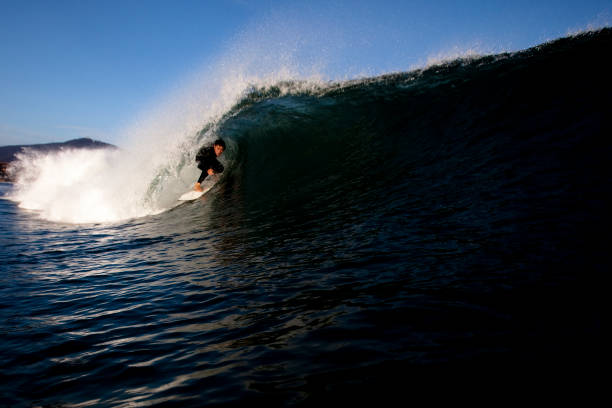
Then you have hollow. Now, hollow is the term that gets every barrel-hungry surfer frothing. A hollow wave is one that throws a perfect, curling lip that creates a tube. The more hollow, the deeper the barrel. When a wave is hollow, it means the water is sucking up off the reef or the sandbar, creating an open space inside the wave face. The most hollow waves in the world, places like Teahupo’o or Jaws, are almost terrifying in their perfection. A hollow wave doesn’t just break. It pitches. It throws a curtain of water that you have to drive through or get swallowed by. There’s nothing like the sound of a hollow wave. It’s a deep, sucking roar, followed by an explosion of spray. Getting shacked in a hollow wave is one of the purest stoke-filled experiences a surfer can have. But it’s also a gamble. If you’re too deep, you get rag-dolled. If you’re too far out, you miss the tube completely. Hollow waves demand precision. They’re the ones that make the highlight reels and the ones that can send you to the hospital.
And then there’s critical. This is the word that separates the average session from a life-defining one. A critical wave is one that leaves you no margin for error. It’s a wave that breaks with such intensity and in such a shallow spot that your positioning, your timing, and your commitment have to be absolutely dialed. A critical wave is often thick and hollow, but it’s the danger that earns it the title. Think of a low-tide session at a slabby break. The water is shallow, the reef is jagged, and the wave is pitching directly onto the rock. That’s a critical wave. You can’t bail. You can’t hesitate. You either make the drop and get barreled, or you take a high-impact wipeout that might end your session and your health. Seasoned surfers talk about a wave being critical in the same way that climbers talk about a route being treacherous. It’s a test of soul. When a wave is critical, the lineup thins out. The groms and the tourists paddle in. Only the locals and the lunatics stay. Those waves forge legends.
The magic happens when a wave is all three. Thick, hollow, and critical. That’s the holy grail. That’s the wave that makes you forget about every other thing in your life. It’s the wave that the old-timers still talk about over a morning coffee. It’s the wave that feels like pure adrenaline and pure fear mixed into one glistening, shifting wall of water. When you paddle out and see a set like that coming, you don’t think. You just go. You paddle with everything you’ve got, you pop up, you drop in, and you commit. If you make it, you come out smiling a smile that cannot be faked. If you don’t, you get the washing machine. But either way, you earned a story. That’s the gnarly life. That’s why we chase the sun and paddle out in the morning.