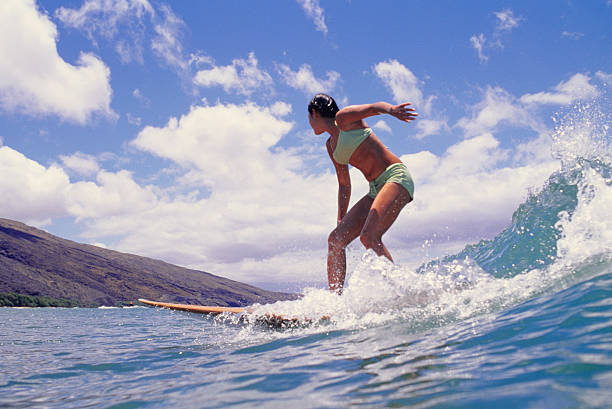
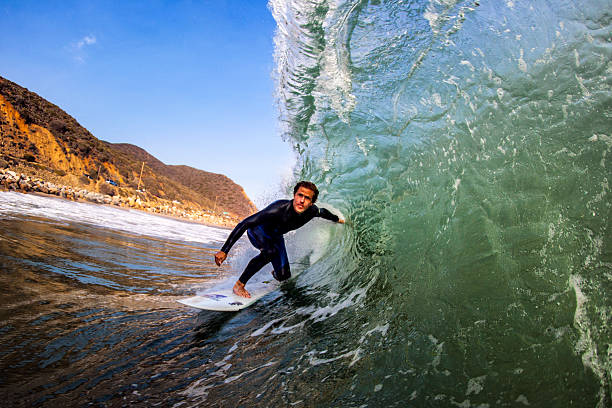
There is no teacher quite like a shifty beach break when you’re paddling out alone with no one to whisper the currents into your ear. You learn to read the ocean like a language, a conversation between the swell and the sand that changes with every set. Out here, on a stretch of coast you’ve never seen before, with a board that feels familiar but a lineup that does not, you become a student of the water. And that is the whole point of solo surf travel, isn’t it? You trade the comfort of a local crew for the raw education of the elements. You learn to trust your own eyes, your own instincts, and the subtle feedback of your fins as the energy of the sea pushes you one direction or another.
A beach break is not a point break with its predictable peeling walls. It is a living, breathing organism that rearranges itself with every tide. The sandbars shift overnight, sometimes after a single set of waves. What worked as your takeoff zone in the morning session will be a closeout mess by lunch. The solo traveler has to develop that sixth sense for reading the water’s surface, the darker patches of deeper water, the telltale foam lines that betray where the sand is piling up. You watch the horizon for the bump of an incoming set and then you watch the crowd, if there is one, to see where the more experienced locals are sitting. But you never just follow the pack as a solo surfer. You sit wide, you watch the patterns, and you find your own slot because the pack might be wrong or they might be guarding a peak you can borrow once they are done.
The most important skill for a solo surfer on a shifting beach break is the willingness to move. You cannot park yourself in one spot and expect the waves to come to you. The ocean has a fickle sense of humor. You paddle up the beach, then down the beach, chasing the pulse of the waves. You get comfortable being uncomfortable, sitting in a spot that feels deeply weird at first, only to have a set swing right onto your head. That is the game. You burn the energy on paddling, on repositioning, on constantly recalibrating your understanding of what the swell is doing. And when you finally catch one, a clean left or a wrapping right that you earned by paying attention, the wave feels like a secret the ocean shared with you alone.
Nobody warns you about the loneliness of a backwash on an unfamiliar beach break. When you take off on a big set wave and the lip throws and the water suddenly boils up from the bottom, pushing the board sideways, you realize that no one in the water knows your name. You have no buddy to watch your back, no local to wave you into the set. The responsibility falls on you alone. That is the price of solo travel but also the reward. You learn to bail deep, to hold your breath through the spin cycle, and to come up calm with your board leashed to your ankle. You learn to smile through a wave that could have been a beating but turned into a lesson. Every closeout, every unexpected shorebreak hammer, teaches you something about your own limit and the ocean’s capacity to humble you.
There is a flow state that opens up when you stop fighting the shifty nature of the break and accept it as part of the dance. You stop demanding that the wave be perfect. You stop comparing the session to the one back home. You just exist in the moment, watching the glint of the sun on the water, feeling the pull of the rip current that you can use as a free ride out to the lineup. You learn to paddle smart, not hard. You learn to duck dive with your eyes open, seeing the world underwater for a brief second before you pop up and scan the horizon for the next set.
And when you paddle in, tired and salt-bleached, with wax crusted under your fingernails and sand in every crevice, you sit on the beach and watch the waves keep crashing. The break will shift again tonight. The sand will rearrange itself while you sleep. Tomorrow, the whole puzzle will be different. But you will be ready, because you are a solo traveler who has learned to listen. That is the endless summer, right there, in the patience of a surfer who trusts the ocean enough to go it alone.