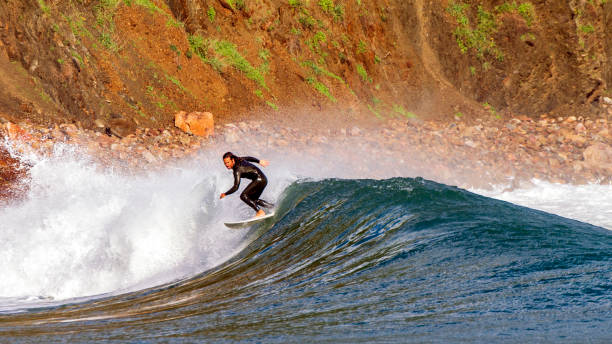
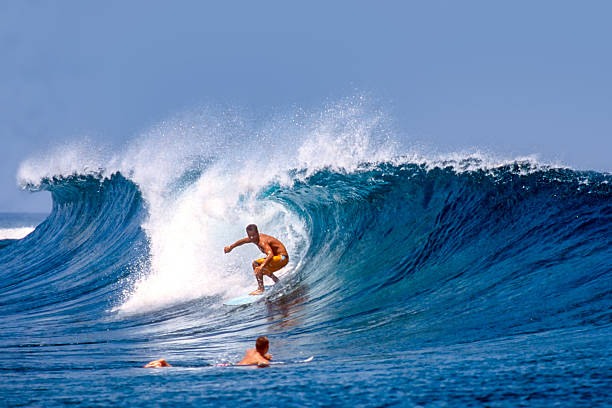
Every surfer knows the feeling. You paddle out past the shorebreak, the salt spray hitting your face, and as you sit on your board in the lineup, you realize it’s not just the waves you gotta read. It’s the vibe. The lineup has its own language, its own code, and it ain’t written down anywhere. But if you don’t speak it, you’re gonna find yourself on the wrong end of a stink-eye or, worse, a paddle handle to the dome. The lingo of the lineup isn’t just about naming waves and maneuvers—it’s about navigating the complex social order that floats between sets. And at the heart of it all lies the ancient, unspoken dance known as localism.
Now, localism gets a bad rap. Outsiders hear the word and they think of territorial kooks chucking boards on the beach, or salty old salts screaming obscenities from the shore. But in truth, localism is just a form of respect, man. It’s the recognition that certain breaks have a rhythm built over years, even decades, by the people who surf them day in and day out. The local crew knows the sandbars, the tide swings, the rips that suck you out, and the rocks that’ll chew your fins. They earned that knowledge through time and sweat, not from a surf report app. So when you paddle out to a new spot, the first word you gotta know is “respect.” Not a slang term, but the foundation of every other piece of lingo you’ll use in the lineup.
Take the “drop-in,” for example. That’s when you take off on a wave that already has a surfer riding it, especially from the peak. It’s the cardinal sin of the lineup. Every surfer knows the term, but the nuance is deeper than you think. There’s a difference between a drop-in and a “snake.” Snaking is when you paddle around someone who’s clearly deeper, closer to the peak, and you steal their wave at the last second. That’s a burning offense, and the local crew will let you know with a dirty look or a shouted “Hey, brah, that’s mine!” That’s the moment you learn “burn” or “burned”—as in, “You just burned me, dude.” If you don’t apologize quick, you might get a reprimand in the form of a spray from the local’s tail as they carve a turn in your face. That’s called a “cutback” with a message.
Then there’s “priority.“ In a crowded lineup, priority goes to the surfer who is deepest, most inside, or has been waiting longest. The lingo around priority is all about positioning. You’ll hear guys say, “I was in the slot,” meaning they were at the point of peak takeoff. Or “I got wave count,” meaning they’ve earned the right to a wave based on waiting. The unwritten rule is that you don’t paddle for a wave if someone is already in position. You drop in on them, and you’re a “wave hog” or a “kook.” And a kook is the worst insult in surfer speak—a person who doesn’t understand the culture, who paddles like a spaz, who drops in without awareness, and who generally kills the stoke. Nobody wants to be the kook in the lineup.
But the lingo isn’t all about conflict. There’s also the beautiful side of the lineup: the “party wave.” That’s when a set rolls in and two or three surfers share the same wave, spread out on the shoulder, laughing and hooting. It’s the opposite of a drop-in. A party wave happens when there’s friendly space and mutual stoke. You’ll hear someone yell, “Go, brah! I got the next one!” That’s the language of generosity. And that’s where “sharing the stoke” becomes the highest-level term. The lineup is a tribe, and like any tribe, it has its leaders—the “old salts” or the “local legends” who have been surfing that break since before most of us were born. They might look grumpy, but if you show humility, you’ll earn a nod, maybe even a “nice wave, brah” as you paddle back out.
The lingo also includes “cleaning up” when a set sweeps everyone off their boards, or “getting shacked” when you’re barreled deep. But the most important unspoken phrase is “respect the pecking order.” That doesn’t mean you’re a punk who bows to some surf gang. It means you watch, you listen, you read the wave priority by observing who’s been sitting deepest. And you use the lingo to show you care. Saying “cheers, mate” or “thanks, brah” after a wave goes a long way. Even a simple “my bad” if you accidentally drop in can defuse a tense situation faster than a surfboard leash can snap.
In the end, the lineup is a conversation without words, spoken through the language of positioning, timing, and mutual respect. The lingo of the lineup isn’t just about naming things—it’s about belonging. It’s about knowing when to take off and when to pull back, when to hoot and when to hold your tongue. That’s the real surfer speak. That’s the dialect that keeps the stoke alive, session after session, break after break.