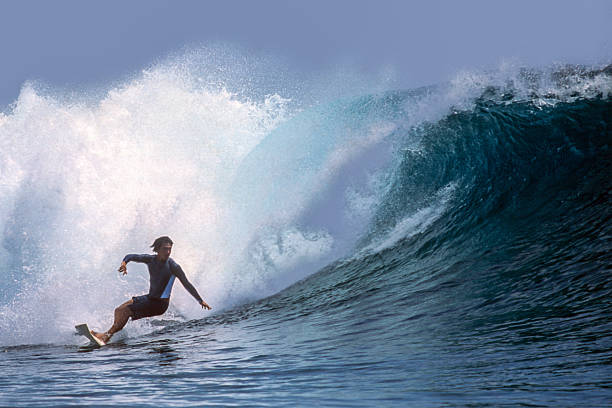
There’s a moment every surfer knows too well when the dawn patrol swells into a frothing mass of fiberglass and elbows, and the ocean that once felt like a private cathedral turns into a parking lot of egos. The wave face is still clean, the horizon still promise, but the vibe can go sideways faster than a late takeoff on a shallow reef. That’s when the real test begins, not of your bottom turn or your pop-up, but of your connection to something deeper than the sport itself. That something is aloha, and in the water, it ain’t just a word you toss around like shaka. It’s a whole way of being, a silent code that separates the surfers who earn respect from the kooks who just take up space.
Aloha gets thrown around on T-shirts and tacky souvenir magnets, but in the lineup, it reveals its true grit. It whispers through the unspoken rules that keep every one of us from getting clocked in the head with a fin. When you paddle out into a crowd, you’re not just entering a lineup. You’re stepping into a living conversation where aloha is the grammar. It’s reading who’s been waiting longest on the peak and giving them first crack at the set. It’s dropping in on nobody and never, ever snaking a wave for the sake of your own ego. The surfer who lives aloha doesn’t even think about these things because they’re baked into the marrow, like the way you know a tide change by the feel of the water. But when someone forgets, the whole lineup feels it, a ripple of tension that turns a glassy morning sour.
The true spirit of aloha runs way deeper than just being polite in a crowded zone. It’s about mālama, caring for the ocean that gives us everything we love. That means packing out your trash, not walking on coral, and understanding that the sea isn’t a resource to be conquered but a lifeline to be cherished. It’s about recognizing that every drop of salt water carries the stories of generations, from the ancient Hawaiians who rode waves on alaia boards with nothing but pure connection to guide them. Those early surfers didn’t have leash rules or priority systems. They had aloha, a reverence for the wave and for each other, a sense that riding the sea was a sacred act of gratitude. When you paddle out with that mindset, you’re not just catching waves. You’re carrying a torch that’s been burning for centuries.
Aloha also shows up in the small moments that only a surfer would notice. It’s sharing your wax when a buddy forgets his, or giving a beginner a tip on where to sit instead of snarling when they paddle in your way. It’s the nod you give the old-timer who’s been surfing this break since before you were born, a nod that says, “I see you, I respect you, and I’m grateful to share this water with you.” That nod, that quiet acknowledgment, is aloha in its purest form. It turns strangers into a temporary ohana, a family bound by the ocean’s pulse, where the chatty guy on the log and the grom in the oversized wetsuit are all part of the same wave-worshipping tribe.
In a lineup that’s soup-thick with bodies, aloha becomes the difference between chaos and harmony. You see it when a surfer catches a wave and lets out a hoot, not out of arrogance but pure stoke, and the whole crowd responds with a cheer. You feel it when someone wipes out hard and three different people paddle over to make sure they’re okay. Aloha isn’t a rulebook written on a plaque. It’s living, breathing, moving like the swell itself, shaping every interaction, every exchange, every shared glimpse of a glassy sunset session that ends with everybody smiling on the sand, salty and spent.
The world outside the water could learn a thing or two from this, but that’s not our problem right now. Right now, the tide’s pushing, the wind’s dropping, and there’s a set feathering on the horizon. You can either paddle out with a clenched fist, ready to fight for every scrap of a wave, or you can paddle out with an open heart, ready to give and receive the spirit of aloha. One way, you’ll catch a few waves and leave feeling empty. The other, you’ll join a sisterhood and brotherhood that stretches across every beach, every reef, every point break on this blue planet. That’s the secret, brah. Aloha isn’t about being nice because you have to be. It’s about realizing that every surfer next to you is the same as you, chasing the same endless summer, riding the same fleeting moment of grace. When you treat that moment as sacred, and the people in it as family, the lineup becomes a sanctuary instead of a battleground. And that’s a wave worth catching every single time.