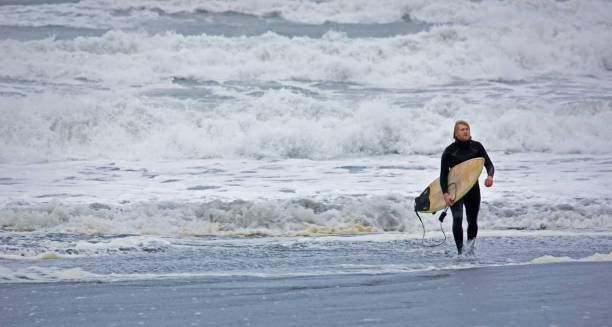
You paddle out on a crisp dawn patrol, the ocean glassy but with a pulse of southwest groundswell rumbling underneath. You’re sitting in the lineup, chest-deep in the blue, watching a set feather on the horizon. That little coil of urethane wrapped around your ankle, trailing a thin cord to your board, is easy to ignore. But let me tell you, that humble piece of gear is the unsung hero of modern surfing. Before the leash became standard issue around 1971, courtesy of Pat O’Neill’s legendary tinkering with surgical tubing and a Velcro strap, losing your board was a genuine epic. You’d be swimming for your life, chasing a runaway thruster that was bouncing down the face like a pinball, while the next wave cleaned you up. The leash changed everything. It kept the stoke alive by keeping your board within reach, and it turned a simple session into a safer, more connected dance with the ocean.
Now, not all leashes are created equal. You’ve got to match your cord to your craft and your conditions. If you’re ripping on a groveler in knee-high slop, a skinny 5mm leash will do the trick, letting you whip that board around without dragging an anchor. But when you step up to a step-up board for some overhead machine, you want a beefier 6mm leash, maybe even longer, to handle the drag and the whip of a big drop. The length matters too. A longer leash gives you more slack to play with, which is rad for deep barrel riding when you need to kick out and the board shoots back to you like a loyal dog. But it also creates more drag when you’re paddling, like a sea anchor slowing you down. A shorter leash keeps things tight and responsive, but if you get caught inside on a double-up set, that board is coming back at your face with a vengeance. It’s all about finding the balance between freedom and connection.
The real magic of the leash is the safety net it provides. When you wipeout on a slab and get rag-dolled into the deep, your board is out there somewhere, tethered to your ankle. That tether prevents you from getting separated from your flotation device. After a few seconds of underwater tumble, you feel that gentle tug, and you know which way is up. That tug is a lifeline. It pulls you back to the surface, back to your board, back to the rhythm of the ocean. In a life-or-death situation, a leash can be the difference between a gnarly story and a tragic headline. That’s not hype, that’s facts. Look at any big wave session at Waimea or Jaws, and you’ll see guys using specialized heavy-duty leashes, thick as your thumb, because losing board in that kind of violence is not an option. The leash is the one thing that holds the whole session together when everything else goes sideways.
But the leash ain’t just a safety device, it’s a subtle tool for performance. It lets you throw your board around on the lip without fear of it careening into the crowd. When you launch a full-roof air, the leash keeps your ride nearby, so you can land, spin, and continue your line without a frantic paddle back. It also lets you communicate with the wave in a more fluid way. You can use the tension of the leash to pop your board back to your feet after a deep duck dive, accelerating your paddle and getting you into position faster. Watch any pro heat, and you’ll see them on the inside, using their leash to snap their board up and over the whitewater with a casual flick of the ankle. That’s the kind of stoke that only comes from a reliable cord.
Of course, there’s a dark side to the leash. It can snag on a reef or a rock and hold you under in a gnarly situation. That’s why you should always wear a quick-release system when surfing heavy, shallow slabs. You know, the kind with a swivel and a pull-tab that lets you ditch the whole rig in a heartbeat. It’s a bummer to have to sacrifice a board, but it’s a better bummer than getting pounded into the abyss. You also got to watch out for leash tangles. The Velcro strap on your ankle can twist, and the cord can wrap around your fins, turning your smooth glide into a clumsy chop. A quick check of your leash every time you paddle out can save you a headache. Make sure there’s no frays, no nicks, and that the swivel is spinning like a top. A worn leash is a ticking time bomb.
At the end of the day, your leash is the quiet companion that makes every session possible. It’s the cord that ties you to your stoke, to your board, to the untamed energy of the sea. Next time you strap in for a paddle, give that little piece of urethane a silent thank you. It’s the unbroken bond that keeps you in the game, chasing endless summers and hollow freight trains. Surf hard, surf safe, and stay connected.