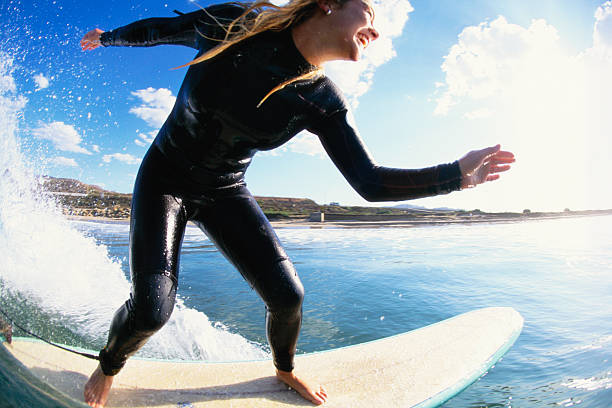
The ocean doesn’t care who you are. It doesn’t check your credentials, doesn’t ask for a birth certificate, and sure as hell doesn’t look at your gender before it decides to throw a twenty-foot wall of water at your face. That’s the beauty and the terror of the sea. It’s a pure thing, a level playing field where only heart, skill, and a deep respect for the swell mean anything. But for a long, long time, the lineup had a glass ceiling, and women had to break it with their bare hands. One of the women who shattered that glass with a fearless, powerful stroke was Sarah Gerhardt, the first woman ever to paddle into Mavericks.
Back in the late nineties, Mavericks was this ghost story whispered amongst the heaviest big wave chargers in the world. A cold, shifty, shallow reef break just north of Half Moon Bay, where the water felt like it had been filtered through ice and the waves could jump from nothing to a thundering, mutated peak that seemed to breathe on its own. It was a man’s world, not because the men said so, but because the conditions were so gnarly that only a handful of the most seasoned surfers even attempted it. Sarah wasn’t trying to make a statement. She was just a surfer with a dream, a woman who loved her boyfriend, Ken “Skindog” Collins, and who’d gotten absolutely hooked on the idea of tackling this monstrous wave. She didn’t think about being a trailblazer. She just wanted to be out there, sitting in the cold gray water, wondering if she was completely insane.
Her journey wasn’t glamorous. There were no film crews following her, no sponsors lining up to throw her free boards. There was just a lot of fear, a ton of paddling, and the cold, hard truth that every time she went out, she might not come back in the same shape she left. Sarah had to fight for her place in that lineup, dealing with the skepticism of the old guard, the guys who thought a girl had no business being out there. But the thing about Sarah, the thing that made her so special, is that she didn’t fight with words or anger. She fought with pure determination. She did the grunt work, paddled for hours, took her lumps, got absolutely smoked by waves that would make most people cry, and she kept coming back for more. She fell in love with the raw, unpolished power of Mavericks, and she learned its moods, its dark secrets, its shifting lines.
In 1999, the swell came. It was forecast to be a proper monster, with wave faces pushing forty feet, a pulse that shook the seafloor. The surfers who got the call were amped, ready to charge. Sarah was out there, sitting in the lineup with Skindog and a handful of other elite chargers. This was it. The moment she’d been training for. The wave came in as a dark, glassy, moving wall of water, and Sarah didn’t hesitate. She put her head down, stroked into it with everything she had, and dropped. That drop is a terrifying thing, a near-vertical plummet into a trough that feels like it’s going to swallow you whole. But Sarah made it, drew a bottom turn that carved a clean arc across the face, and then flew down the line, a solitary figure on an impossible canvas. She didn’t just survive it. She nailed it. She made the wave and then had to fight her way back outside, her heart pounding, her eyes wide with the stoke of a lifetime. That ride didn’t just make history. It rewrote the story of what women could do in the water.
Sarah Gerhardt didn’t see herself as a political symbol. She was just a surfer, chasing that same endless feeling that drives all of us. But her legacy is massive. She opened a door that had been bolted shut, and through that door came Maya Gabeira, who later charged Nazaré to record-breaking heights, and Keala Kennelly, who paddled and towed into heavy reef faces that made the old men wince. Sarah showed that big wave surfing wasn’t a test of testosterone, but a test of the human spirit. She proved that if you put in the time, if you respect the ocean and push your limits, the wave doesn’t care if you’re a girl. It just cares if you’re all in. That’s the real lesson. It’s not about being a woman in a man’s sport. It’s about being a surfer who refuses to be told “no.“ The ocean is a misogynist’s worst nightmare because it genuinely gives back what you put in. Sarah Gerhardt put in the work, and she got the ride of her dreams. She’s a legend, not because she’s a female legend, but because she’s a legend, period. And every time a girl paddles out at a big break and feels that flutter of fear, she’s standing on Sarah’s shoulders, ready to charge.