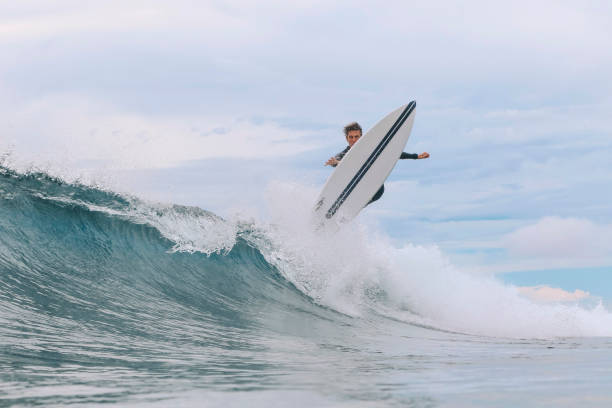
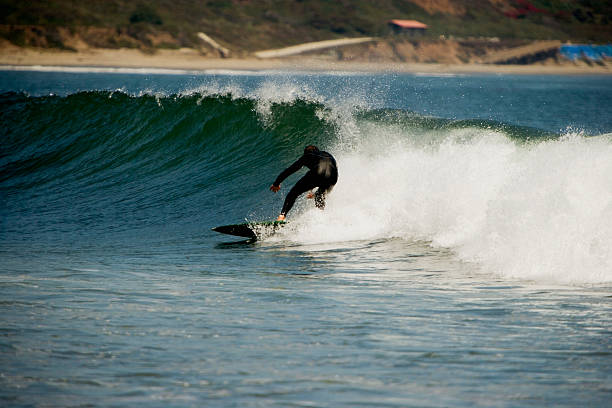
You paddle out on a clean morning, the ocean glassing off like it just got a fresh coat of wax. The waves are peeling down the point, perfect righthanders for days. You’re a regular-footer, so that wave is your bread and butter—backhand snap off the top, full rail carve through the pocket, everything feels dialed. But then one set swings wide and a left cranks open right in front of you. Your heart says go, your brain says maybe not. Because facing the wave with your weak foot forward is like trying to write your name with the wrong hand. That’s the dance we all know: goofy vs. regular. But the real magic isn’t just picking a side—it’s learning to ride both.
We all get born into a stance. Maybe you skateboarded first, and your left foot just felt stable up front. Maybe you stepped onto a boogie board as a kid and the ocean decided for you. Regular-foot means left foot forward, goofy-foot means right foot forward. There’s no superiority, just preference, like being left-handed or right-handed. But here’s the thing: the ocean doesn’t give a hoot about your comfort zone. The best waves rarely care whether you’re a goofy-foot from Florida or a regular-foot from the North Shore. That wave is breaking left or right, and you either adapt or sit there watching someone else get shacked.
That’s where the switch stance shuffle comes in—the grind of learning to surf with your opposite foot leading. It’s a deep dive that most surfers avoid like a shallow reef on a big swell. Why? Because it’s humbling. You’ve spent years building muscle memory, reps, and reflexes in your natural stance. Your pop-up is automatic. Your bottom turn flows off the back foot. Your eyes find the lip without thought. Then you switch, and suddenly you’re a kook again. The wave looks upside down. Your backhand feels like a stranger’s arm. You eat foam on drops you’d normally float through with a smile.
But here’s the stoke: riding switch transforms your entire relationship with the ocean. First, it unlocks double the waves. A goofy-foot who can also ride regular can hunt down peaks from either direction without paddling away in shame. That’s more rides per session, more waves caught, more practice per hour. Second, it forces this incredible full-body awareness. When you ride your non-dominant stance, your brain lights up in new places. You’re forced to re-learn foot pressure, weight distribution, and shoulder rotation from scratch. That rewiring makes your natural stance sharper, too. Your weak side becomes a mirror that shows you exactly what your strong side does automatically—the subtle habits you never noticed, the small inefficiencies you can now correct.
There’s also the pure freedom of it. Think of the classic endless summer vibe: traveling to a new spot, a swell from a weird angle, a river mouth that jacks both ways. If you’re locked into one stance, you’re locked into half the menu. Riding switch is like having a backstage pass to every peak on the planet. You can chase the sun and the surf without worrying if the wave goes left or right. You become the surfer who casually drops in on the “wrong” direction and still makes it look smooth, leaving everyone scratching their heads.
So how do you start? It ain’t glamorous. First, ditch the surfboard and grab a skateboard or a balance trainer. Push around with your opposite foot forward until standing feels natural. Then pop-up on dry land—on a beach towel, a yoga mat, your living room floor—just repeating the motion until your legs stop arguing. When you hit the water, choose a soft, crumbly whitewash wave on a foamie. Take off way more straight than you normally would, keep your knees deep and your eyes glued to where you want to go. Let your back hand stay loose and low. Accept that you’ll catch rail. Accept that you’ll eat it. Laugh about it. The ocean doesn’t judge.
The mental game matters as much as the physical. Your brain will tell you this is wrong, that you should be goofy, that the wave is somehow off. Ignore that voice. Focus on tiny victories—a clean pop-up, a solid bottom turn, a single cutback that doesn’t end in a spinout. Each one rewires that stubborn neural pathway. Pretty soon, your “shadow side” becomes just another arrow in your quiver. You’ll start choosing the switch stance just for variety, just to feel that childlike wobble again. That’s the soul of surfing, after all—not perfection, but the eternal stoke of asking the wave to teach you something new.
So next time you’re sitting in the lineup and a left peels through, don’t hesitate. Paddle forward, switch your feet, and drop in like you own the place. The fall will be worth it. The ride will be even better.