There’s nothing like that moment when you drop into a pitching wall of water, the lip hucking over your head, and everything goes quiet except for the roar of the ocean. Getting slotted into a barrel, or as we call it, getting shacked, is the holy grail of surfing. But it ain’t luck. It all starts before you even take off, with where you sit in the lineup. Positioning for the tube is a whole different game from just catching an average wave, and it’s something you feel more than you think about once you’re inside.
Every wave that’s gonna barrel has a sweet spot called the pocket. That’s the critical section where the wave is steepest, just before it throws out. If you’re too far inside, you’ll get caught in the whitewater and blown off your board like a ragdoll. If you’re too far outside, you’ll be paddling for a wave that never really stands up, or you’ll be so late that you can’t get your rail in before the lip crushes you. The trick is to read the swell direction, the bathymetry, the tide, and the set frequency to know where the peak is gonna unload. For a barreling wave, you want to sit right at the focal point, the spot where the wave starts to jack up and the shoulders feather. That’s ground zero.
Take a reef pass like Pipe or Teahupo’o. The wave there is not just a rolling line; it’s an arc that bends around a shallow shelf. The takeoff zone is tight. You paddle for the deepest part of the peak, often a little inside of where you’d normally take off on a mellow point break, because you need that initial speed to beat the curtain. If you sit too far on the shoulder, you’ll either get a runners wave that doesn’t barrel, or you’ll be forced to pop up super late and try to squeeze under a lip that’s already throwing out two feet above your head. Both endings suck.
Your positioning changes with the tide, too. Mid tide usually gives you a suckier, more critical barrel because the water rushing off the reef creates a steep, hollow face. Low tide can produce fat, riskier barrels that close out fast, while high tide might make the wave fatter and harder to get into. You gotta factor that into where you sit. Even a shift of a meter can mean the difference between a perfect pit that spits you out and a wipeout that puts you through the ringer.
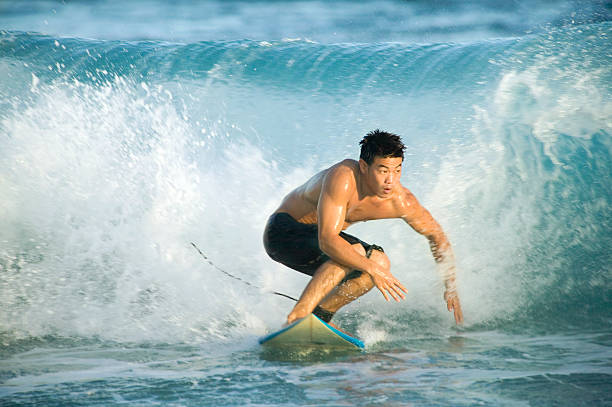
Once you’ve found your spot, paddling into a tube wave demands a different timing. You don’t just stroke casually. You punch hard, with your chest up, and you angle your takeoff much deeper than a normal wave. You want to drop almost straight down for a split second, then immediately lay your bottom turn high on the face, almost like you’re trying to ride the falling curtain. That motion sets your line for the barrel. Your eyes should be locked not on the lip, but on the exit. You’re looking for the light, the bright circle at the end of the tunnel. That’s your target.
Positioning doesn’t stop at the takeoff. Inside the barrel, your body position becomes your guide. If you get too far forward on your board, you’ll pearl and get sucked over the falls. Too far back, you’ll stall and the wave will eat you. You need to stay low, with your weight centered, and your hands often dragging on the face to keep your board stuck to the water. That subtle weight shift can steer you deeper into the pocket or help you accelerate out to the shoulder. And you have to be ready to pump, to generate speed even in a tiny tube, because a barrel can close up fast.
The best barrel riders make it look effortless, but that’s because they’ve internalized a whole set of variables. They know that every spot has its own lineup marker—a rock, a palm tree, a landmark on the cliff—that tells them exactly where to sit for a given swell. They study the ocean before paddling out. They watch where the previous sets broke. They feel the lull between sets and adjust. The real pros don’t just sit and wait; they’re constantly repositioning, drifting with the current, making micro adjustments based on what the ocean is telling them.
So next time you paddle out and the waves look like they’ve got a chance of going hollow, don’t just follow the crowd. Find your own peak. Commit to that deep takeoff line. Let the wave decide if you’re worthy. Because the barrel is not a reward you get for being in the right place at the right time. It’s a conversation between you and the wave, and it begins with where you choose to sit.