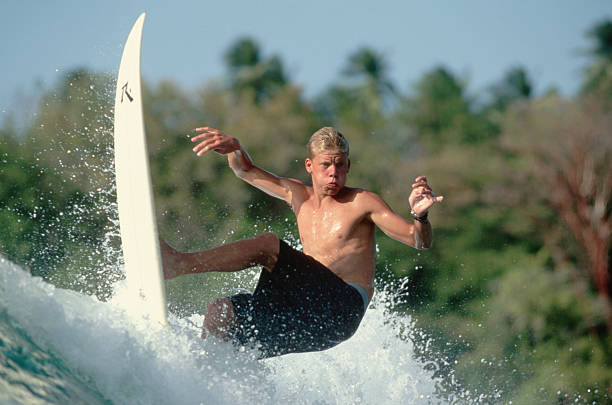
Imagine paddling out at your local spot, the kind of place you’ve surfed a thousand times. You know every rock, every rip current, every seam where the wave gives you a little extra push. But the wind, man, the wind is a tricky character. You look at the forecast, and it tells you the wind is solidly onshore, ten to twelve knots straight into the beach. You think, “Bummer, another choppy, blown-out day.” You’re already resigned to a session of fighting whitewash and getting pitched into the flats. But then you get there, you paddle around the headland, and you feel it—a subtle shift. The water is actually relatively clean. There’s a slight texture on the face, sure, but the wave is standing up, holding its shape, peeling down the point like it’s got a secret. What’s happening, brah? You’ve just stumbled into a micro-climate.
In the world of surf lingo, we throw around “offshore” and “onshore” like they’re the only two sides of a coin. Offshore is the holy grail, the wind that grooms the wave, holding it up for that extra second so you can get a deep barrel or a long, drawn-out carve. Onshore is the enemy, the choppy, lumpy chaos that turns a clean swell into a washing machine. But the ocean and the coastline don’t always read the forecast. The real truth is that wind is never a perfect, uniform blanket across the entire coast. It wraps, it deflects, it accelerates over ridges and through valleys. It creates these little pockets of magic, these hidden safe zones where the onshore wind suddenly seems to lose its nerve.
Take a classic point break setup. The swell is coming in from the northwest, and the wind is blowing straight from the south-southwest. Textbook onshore. But if there’s a big cliff, a tall sand dune, or a dense patch of trees growing right on the point, the wind doesn’t just blow straight through. It gets blocked. It gets pushed up and over, creating a wind shadow that drops down on the inside of the wave. You might be paddling out into a total mess, but the moment you duck-dive through the whitewater and pop up on the shoulder, you’re in a different world. The wind is actually blowing sideshore, or even slightly offshore, because it’s wrapping around the geological feature.
This is where the local knowledge really comes into play. The old guys on the beach have been watching the same piece of coastline for thirty years. They know that when the wind is supposed to be straight onshore, the wave behind the jetty at the mouth of the river is actually glassy clean for four hours after dawn. They know that the wind doesn’t even start to blow until ten in the morning in that specific cove, so if you can wake up early enough to catch the dawn patrol before the sea breeze kicks up, you’ve got a window of gold. It’s not just about checking a wind meter online; it’s about reading the trees, watching the flags, and feeling the puff on your cheek as you stand on the sand.
You also have to consider the phenomenon of the “sea breeze” versus a synoptic wind system. A low-pressure system pushing through the coast is a different beast entirely from the daily thermal sea breeze that kicks up when the land heats up faster than the water. That sea breeze is fickle. It builds throughout the morning, peaks in the afternoon, and then dies off at sunset. In many spots, that onshore sea breeze is actually your friend. It’s predictable. If you know the wind is going to blow straight into your favorite beach from 11 AM until 3 PM, you plan your session to miss the worst of it. But if there’s a sheltered corner, a point that faces north while the wind is blowing from the south, you can be sitting in perfect offshore glass while the rest of the county is eating the slop.
And let’s not forget the “lully” wind. That’s the surfer’s term for a wind that comes in bursts. It’s not a steady, chaotic chop but a series of puffs. For ten seconds, the wave is clean. You take off. Then, right as you’re setting your rail, a puff of onshore nukes the face, and you’re suddenly surfing a minefield. You have to adapt, to read the rhythm of the wind almost like you read the rhythm of the swell. A truly tuned-in surfer can feel a puff coming before it hits the water. They see the cat’s paws on the surface, the little dark patches of ruffled water, and they know to pull back, to stall, to wait for the calm window.
In the end, chasing the endless summer isn’t just about finding the biggest swell or the warmest water. It’s about hunting the perfect wind. It’s realizing that your local spot is a living, breathing being with its own personality. The forecast says onshore, but the cliff says something else. The trees say something else. You just have to paddle that extra fifty yards around the corner. You might find that the wind is always offshore somewhere. You just need to know where to look.