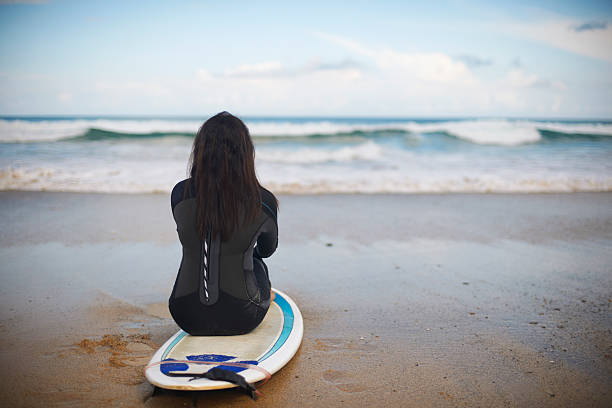
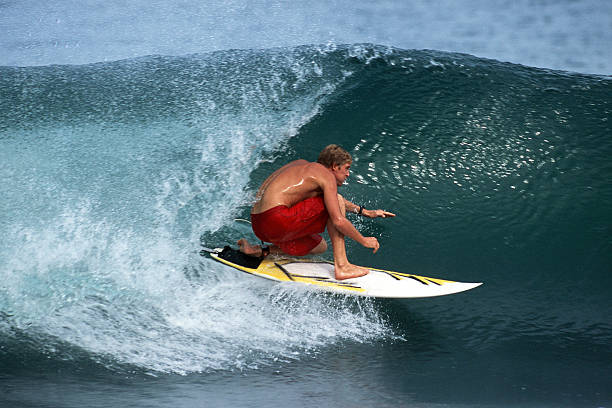
You paddle out, chest heaving, arms burning, and that set sneaks up on you. Not a little reform, not a waist-high fun wave—a real cleanup set, stacked three deep, walls as dark as a late-afternoon shadow. You know you gotta go under. So you grab those rails, push down, and hope for the best. But nine times out of ten, the whitewash snatches your board, rips it from your hands, and sends you tumbling like a sock in a washing machine. What gives? The answer ain’t grit or fear or even how deep you can hold your breath. It’s physics, plain and simple. And once you understand why your board wants so badly to pop back up, you can trick it into staying down.
A surfboard floats. That’s its job. It’s a big slab of foam wrapped in fiberglass, and foam is full of tiny air pockets that make it lighter than water. Archimedes’ principle—the dude who yelled “Eureka” in the bathtub—says that any object submerged in water experiences an upward force equal to the weight of the water it displaces. Your board displaces a lot of water because it’s long and wide. That upward force, called buoyancy, is the same force that lets you ride waves in the first place. But when you’re trying to duck dive, buoyancy is your enemy. It yanks your board toward the surface like a cork in a bathtub. The bigger the board, the stronger the upward pull. That’s why shortboarders can slip under a six-foot wall of foam while a longboarder gets rag-dolled.
The trick is not to fight buoyancy head-on—you’ll lose every time. Instead, you use leverage, angle, and timing to redirect that upward force. When you push the nose of your board down with your hands, you’re creating a pivot point around the center of buoyancy. Your weight presses the nose under, but the tail wants to come up. If you push straight down, the tail rises, catches the wave face, and your board shoots out behind you like a missile. That’s the “barn door” effect. To avoid it, you need to press the nose down and forward, almost like you’re trying to slide the board under the surface rather than stab it. You’re aiming to get the whole board horizontal beneath the wave, not angled like a diving plane.
Then there’s your body. Your arms are strong, but your legs are stronger. A good duck dive uses your knee or foot to pin the tail down. After you push the nose under, drive your back knee onto the tail pad or, if you’re riding something short enough, use your rear foot to stomp the tail deep. This counteracts the buoyancy trying to lift the tail. Now your whole board is submerged, and your weight—plus the force of the wave above—helps drive you down. The wave’s own energy, the violent push of whitewash, actually helps you if you’re in the right position. You’re not just diving; you’re leveraging the wave’s pressure to force yourself deeper.
Timing matters more than strength. You want to start your duck dive a split second before the whitewash hits you. If you wait until the foam is already on top of you, the wave will compress your board against your chest and you’ll get nowhere. You need to penetrate the wave’s face as it’s about to break, punching through the unsettled water where the density is lower. That sweet spot is about a foot below the surface, right where the turbulence is just forming. Dive too early and you pop up before the set arrives; dive too late and you eat foam.
Breath control comes into play, too. You can’t panic. When you exhale just before going under, you reduce your own buoyancy—your lungs are full of air, another air pocket fighting to lift you. Blow out steadily as you descend, and you’ll sink a little easier. But don’t blow it all out at once. Save a little reserve for the second wave in the set, because cleanup sets rarely travel alone. You might need to stay under for three or four seconds, letting one wave roll over you while you hang beneath the surface, board flat, eyes closed, feeling the rumble pass overhead. Then you kick hard with your fins, angle the nose up, and surface ready for the next one.
Some surfers get so dialed into duck diving that they treat it like a meditation. They feel the water’s push and pull, read the set’s timing from the horizon, and go under with the calm certainty of a sea turtle. That’s the goal. Not to muscle through, but to flow with the physics. Your board wants to float—that’s its nature. But you can borrow from the wave’s own momentum to stay down, using your body as a counterweight, your timing as a key. Next time a cleanup set marches in, don’t panic. Archimedes is on your side if you know how to work him.