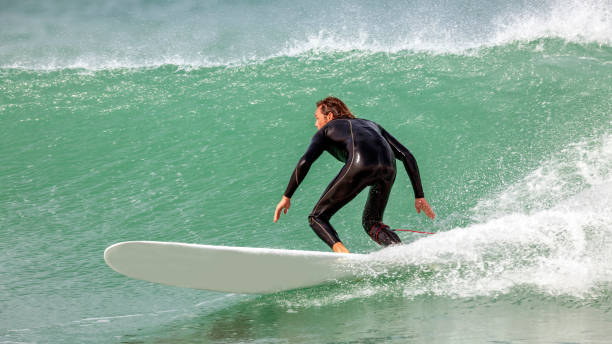
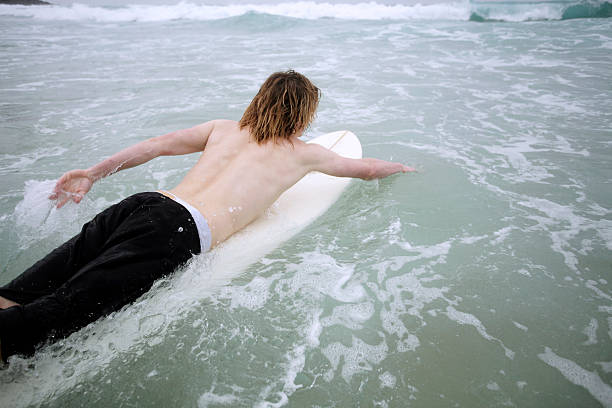
There is a moment every surfer knows, that split second when you see the horizon line lift and darken, and you realize the set is not just coming, it is already upon you. The wave rears up like a wall of liquid stone, and your only option is to go through it, not over it. This is where the duck dive becomes more than a technique, it becomes a survival mechanism. But to truly master the duck dive, to slip through the soup like a hot knife through butter, you need to understand the hydrodynamics at play. It is not just about shoving your board under the water. That is a rookie move that will get you rag-dolled. The real art lies in reading the wave’s energy and using your board as a foil to punch through the turbulence.
When that wall of whitewater bears down on you, the instinct is to push down hard. But brute force alone will not save you. The physics of the duck dive rely on leverage and timing. You want to use your back foot to drive the tail of the board down first, not the nose. This angling is critical. By pressing the tail down, you create a downward pitch that allows the nose to slice cleanly into the base of the wave, where the water is densest and the energy is most concentrated. If you push the nose down first, the board will want to submarine and stall, getting caught in the turbulent upper layers of the soup. Instead, think of it as spearing the wave at its base, aiming for the dark, still water where the energy is just beginning to curl. The rail of your board acts like a knife edge, cutting through the surface tension. The shape of your board matters tremendously here. A thicker, more rounded rail will fight you, creating drag and suction. A sharper, more refined rail will slice through the water with less resistance, allowing you to punch deeper with less effort.
Once you are underwater, you feel the full weight of the set passing over you. This is the moment of truth. The chandelier of whitewater roars overhead, and you are suspended in a pocket of compressed, foamy silence. The key here is to stay compact. Your body wants to fight, to push up against the force, but that will only get you tumbled. Instead, pull your knees into your chest and let the front of your board get as deep as it can go. The fins will create drag, which is actually your friend here. That drag keeps the board from shooting back up to the surface too soon. You want to let the wave’s energy pass over you, feeling it suck and swirl, before you start to angle your nose back up. This is where the timing of the recovery is everything. Too early and you pop up into the lip of the next wave. Too late and you get held down, gasping for air as the entire set stacks up on top of you.
The best duck divers are not the strongest paddlers, but the ones who have developed a feel for the water. They can sense the pulse of the set, knowing when the first wave’s energy has fully passed and when to begin their ascent. This feel comes from hours of practice, from getting worked again and again until your body learns the rhythm of the ocean. Your arms will ache, your lungs will burn, but that is the tuition you pay for the ability to slide through a ten-foot set with the grace of a fish. Remember that the ocean is not trying to hurt you. It is just moving, and your job is to move with it, not against it. The duck dive is a surrender, a moment of yielding to the power of the wave so that you can emerge on the other side, ready to paddle into the next one. When you get it right, there is no feeling quite like it. You surface behind the wave, calm and centered, while other surfers are getting smashed and tossed around like driftwood. That is the reward for understanding the hydrodynamics of the deep duck dive.