You paddle out, sit on your board, and look at the line for the first set of the morning. The horizon is lumpy, a gray heap of water that might give you something or might just roll over like a tired dog on a hot day. In surfer talk, we’ve got a whole vocabulary for what you’re about to ride—from mushy to primo, from dribbly to firing, from closeout to the barrel of your life. If you’ve been around long enough, you know that the difference between a session you’ll never forget and a session you’ll never remember is all in the language you use to read the wave before you even drop in.
Let’s start with the bottom of the scale: mushy. A mushy wave is a lazy wave. It comes in slow, fat, with no real push. The face is soft, the lip dribbles rather than pitches, and you feel like you’re riding a piece of wet cardboard that’s barely moving. Mushy conditions usually happen on a windswell—short-period energy chopped up by onshore wind. The wave doesn’t hold a line; it sections off, crumbling like a sandcastle that got hit by a hose. You still get a ride, but it’s the kind you take when you’re just happy to be in the water. There’s no tension, no real speed, no heart-stopping moment. Just a slide. And that’s fine—nobody’s gonna hate on a soft day when the sun is out and the water’s warm.
A step above mushy is what we call “crumbly” or “sectiony.” These waves have a little more push, but they break unevenly. You might get a nice drop, then the wave wrinkles up into a messy section and you have to pump hard to make it. They’re not clean—the face looks like it’s been through a washing machine. You see a lot of these on a falling tide after a front passes. They’re rideable, but you’re working for every turn. The lingo here shifts to “fat,” “blown out,” or “weak.” Experienced surfers often sit these out, waiting for the tide to change or the wind to swing offshore.
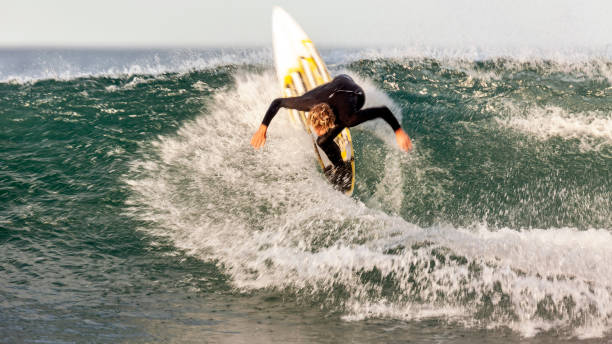
Now we move toward the sweet spot: “chest-high and glassy.” That’s not a linguistic condition but a universal dream. When the wave has enough face to stand up, the wind is light or offshore, and the swell has some groundswell in it—meaning long-period energy from a distant storm—you get what we call “juice.” The wave stands tall, the lip is crisp, and there’s a pocket you can tuck into. This is where you start hearing words like “peeling,” “railing,” and “hollow.” A peeling wave breaks from one end to the other, offering a long ride. A railing wave is one you can really lean into, put your rail in the water and carve. And if it gets hollow—if the lip throws over and the wave forms a tube—then you’ve crossed into primo territory.
Primo is the top shelf. It’s not just about size; it’s about shape, power, and wind. A primo wave is clean, consistent, and offers a legitimate barrel. You hear surfers call it “firing,” “pumping,” “cooking.” The wave has a steep drop, a thick lip that throws, and enough juice to let you get deep. On a primo day, the lineup is tight, people are hooting, and there’s a palpable buzz in the air. You see guys scratching for bombs and coming out of tubes with their arms in the air. That’s the endless summer dream.
But here’s the thing: even a primo wave can go bad if the tide is wrong or the wind switches. That’s why we have terms like “tide-sensitive,” “offshore groomed,” and “windswell chop.” A wave that was firing at low tide might turn into a closeout machine at high tide. Closeouts are the rough end of the spectrum—waves that break all at once, offering a short drop and a gnarly inside washing machine. They’re not necessarily bad for body surfing or for a deep duck dive, but you won’t make the section.
So when you hear a surf report say “conditions are mushy to fair,” you know you’re in for a mellow day. When you hear “primo for the early session before the onshore picks up,” that’s the call to get out of bed. Learn to read the ocean’s mood. Feel the push of groundswell versus the slap of windswell. Watch how the wave stands up on different tides. The more your vocabulary expands, the better you’ll know when to sit and wait—and when to paddle like hell.