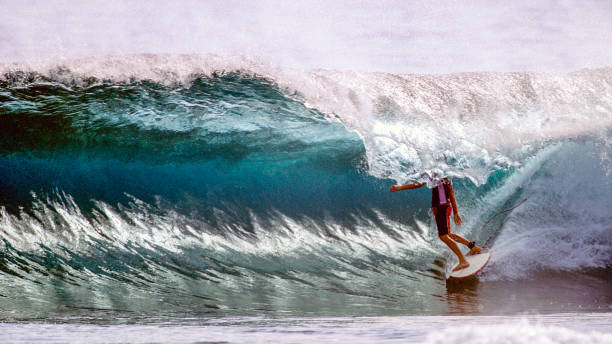
You know that feeling when you drop in on a wave that’s just a bit too steep, the lip pitching out like it’s got a mind of its own, and you jam that hard bottom turn feeling the whole stringer flex beneath your back foot. That moment, that split-second decision to go vertical instead of flying straight down the shoulder, is the single greatest gift the shortboard revolution gave us. But it didn’t happen overnight, and it didn’t happen because some shaper woke up one morning and decided to chop a log in half. The revolution came because a handful of mad geniuses started asking a dangerous question: what if the board didn’t fight the wave, but fit into its curve?
Before the shortboard took over, the old-school heavy guns were beautiful pieces of furniture. They were nine feet of balsa or foam, thick as a picnic table, with rails you could rest a beer on. They caught waves early, they trimmed with a stately glide, and they turned like a cruise ship with a rudder the size of a door. But the wave itself had boundaries, and those slabs of foam hit a wall. When a wave got hollow, when the lip threw out over a dry reef, those longboards just couldn’t get in there. They couldn’t tuck into the barrel. They couldn’t snap off the top. The wave was a master sculptor, and the old boards were too big to fit into its finest cuts.
The breakthrough? It wasn’t just length. It was foil. The shortboard revolution wasn’t about making a board small for the sake of being small. It was about redistributing the volume, tapering the rails, sinking the rocker deeper into the nose, and pulling that tail up like a dolphin’s fluke. Shapers like Bob Simmons had been playing with hydrodynamics since the forties, but it took a new generation of California and Australian craftsmen to realize that a board didn’t need to be a flat, thick slab to float. You could thin it out, soften the rails through the middle, and keep the foam where you actually needed it under your feet. The board started to become a living thing, a foil that could slice into the face of a wave instead of just sitting on top of it.
What that did to the ride was pure alchemy. Suddenly a surfer could push the nose down the face and feel the board bite into the water, not bounce off it. With a more extreme rocker in the nose, you could stall a bit, let the lip catch up, and then drive off the bottom with a explosive release. The tail became a weapon. Squash tails gave you a pivot point for quick, banking turns. Rounded pins let you hold that rail through a long, drawn-out gouge. Swallow tails split the flow and gave you that wild, loose feeling at the top of the arc. For the first time, guys were riding waves that were steeper than the board itself, using the rail as a fulcrum and the fins as a clutch.
And with that came a whole new vocabulary of motion. You couldn’t just walk to the nose and hang five anymore. You had to be planted, coiled, and ready to unload. The shortboard demanded aggression, timing, and a willingness to fall. The old point break trim was out. The new game was the bottom turn, the off-the-lip, the re-entry. Surfing became about the vertical plane. Instead of riding along the wave, you were riding up and down the wave, using its energy like a ramp. The soul of surfing shifted from pure glide to pure attack.
That shift didn’t happen in a vacuum. It was driven by a need to ride more challenging waves, sure, but it was also about a cultural rebellion. The longboard was the dad car. The shortboard was the hot rod. Kids wanted to huck themselves into more critical sections. They wanted board shorts instead of trunks. They wanted to feel the spray off their own fin as they cranked a cutback so tight it left a ripple on the surface. The revolution was as much about attitude as it was about rocker.
These days, we have more choices than ever, longer boards and hybrid shapes that blur the lines. But every time you feel that rail engage and the board hums like a tuning fork under your feet, you’re riding the ghost of that revolution. That foil, that taper, that rocker that lets you fit into a wave like a key in a lock. It set us free from the flat line. It pointed us skyward. And we’ve never come back down.