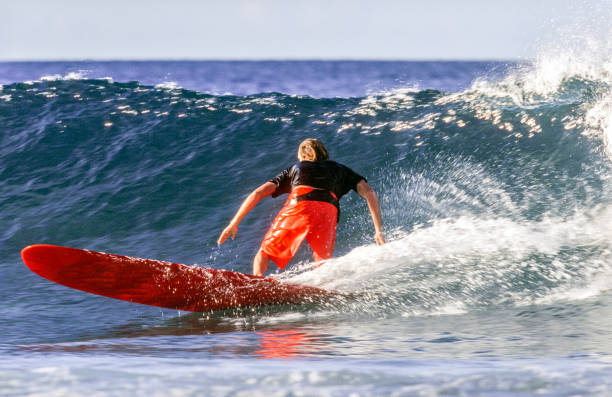
There is a moment just before sunset when the entire coast of Baja California Sur seems to breathe out. The afternoon heat softens, the wind dies to nothing, and the ocean turns to molten gold. You are sitting out at a point break near the elbow of the peninsula, maybe twenty miles north of Todos Santos, maybe south of Ensenada, and the only sound is the hiss of a set feathering on the outside. This is the magic that keeps us coming back to the long, skinny arm of Mexico. It is not just the waves, though the waves are world-class. It is the feeling that you have slipped the moorings of the modern world.
The road south from the border is a pilgrimage. There are still stretches of the old highway that are two lanes of cracked asphalt winding through cactus forests. You pass through fishing villages where the gasoline is sold from plastic jugs and the taco stands serve only fish, caught that morning. The further you go, the more the terrain changes. North Baja is dry and dusty, with cold winter groundswells and howling Santa Ana winds that make the late fall a gamble. But once you push past Guerrero Negro and cross into the peninsula’s southern half, the energy shifts. The water warms. The points begin to bend the swell into perfect lines that reel for three hundred yards.
I remember my first trip to a certain right-hand point near Punta Lobos. The dirt road was washboarded so badly that my suspension cried, and the last mile was nothing but sand. When I finally paddled out, I was alone. The wave was head-high, the offshore breeze was combing the crest into silver spray, and the water was so clear I could see the rocks below. That session lasted until my arms turned to rubber and the sun dropped behind the mesa. I paddled in, walked up the beach, and found a local fisherman grilling yellowtail over a driftwood fire. He offered me a piece with a squeeze of lime and a warm tortilla. No words needed. That is Baja.
The local crew in places like Cerritos and San Miguel are some of the most hospitable chargers you will ever meet. They surf with a raw, functional style born of waves that are always a little heavier than they look. There is no posturing, no lineup hierarchy. You paddle out, you nod, you take your turn. But you better know the rules: don’t snake. Don’t drop in. Respect the elders in the water. If you show humility, they will show you the secret peaks that sit just around the corner, the ones that only work on a big northwest swell and a minus tide.
Living the Baja surf life means embracing a different rhythm. You wake before dawn, not because you have to, but because the morning glass-off is too precious to waste. You check the swell buoys on a phone that barely has service, but mostly you just watch the horizon and trust your instincts. Breakfast is chilaquiles and coffee from a roadside stand. You pack a cooler with water, limes, and tortillas. You drive for an hour down a road that might be impassable after a storm. You find a wave that is uncrowded, maybe even empty, and you surf until the tide runs out. Then you find a palapa, drink a cold Pacifico, and watch the pelicans dive-bomb the evening bait balls.
The equipment for this kind of trip needs to be bombproof. A thruster with some foam under the chest handles the steep drops and the sectiony inside bowls. I bring a step-up if there is any chance of a solid swell, because Baja can send you a double-overhead set out of nowhere, born from a distant storm in the South Pacific. A longboard is nice for the mellow points when the swell is small, but a high-performance shortboard or a hybrid fish works for ninety percent of the waves you will find. Wetsuit thickness depends on latitude. North of Ensenada, you need a four-three in winter. Around Cabo, you might never zip up a suit at all. Board wax melts in the sun, so keep it in the shade. And bring fin keys. Multiple fin keys.
There are dangers, of course. The water is full of life, and some of it has teeth. The roads are unlit, the medical clinics are basic, and the isolation is real. But that isolation is also the draw. When you sit out at the point, alone in the lineup, watching the sun sink into the Pacific, you understand why the early surf explorers like Bob Simmons and the guys from the Makaha crew took the long detour down this desert coast. They were looking for something that the crowded breaks of California could not provide. They found a raw, wild, honest version of the surfing life.
Baja Bliss is not a luxury resort with infinity pools. It is the feeling of salt crusted on your skin after a week of dawn patrols. It is the taste of street tacos eaten with sandy hands. It is the realization that the best wave of the trip did not show up on the forecast, but was gifted by the ocean anyway. That is why we chase the sun down the peninsula. Not for the perfect wave. For the feeling that comes when the wind drops, the tide pushes in, and the reef begins to hum.