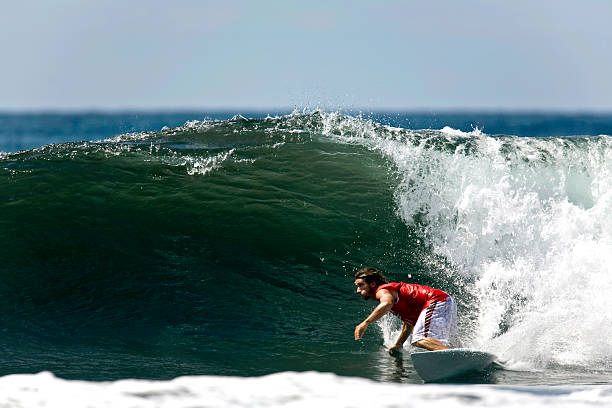
There comes a moment in every surfer’s progression when the wave stops being just a wall to ride and starts feeling like a living springboard. You’re tucked in the pocket, the rail biting deep, water hissing past your ears, and suddenly you realize that the carve you just laid down wasn’t just a turn—it was a loading chamber. The real magic happens when you understand that an air isn’t a separate trick. It’s the explosive end of a carve that never quite finished its arc. That’s the secret they don’t tell you in the lineup: airs are just carves that get so radical, they take flight.
Think about the bottom turn. That’s your foundation, the moment where you commit all your weight to the rail and let the wave’s upward energy compress through your legs like a coil. The easiest way to kill any chance of flying is to rush this part. You need to feel the fins dig, the board flex, and then—when the wave starts pitching or the lip throws out—you unleash that stored force. A proper carve, especially in the critical section, isn’t about slashing wildly. It’s about projecting. Your back hand reaches toward the lip, your front arm guides the rail, and your eyes stay locked on where you want to exit, not where you are. That exit point is your runway.
Now, here’s where the link to airs gets groovy. Every carve has a natural rebound. When you carve hard off the top, the board wants to snap back down because the fins are releasing their grip. Most surfers fight that rebound, trying to stay glued to the face. But if you instead ride that release—let the board come up, let your weight shift slightly rearward, and then drive your front foot down into nothing—you’ve just turned a carve into an air. It’s not about jumping. Jumping is for skate ramps. On a wave, the air should feel like the carve simply runs out of wave and keeps going. The lip doesn’t throw you; you throw the lip.
The trick is to stay loose but intentional. Tensing up is the quickest way to eat it. When you’re carving with the goal of an air, you want to compress low through the turn, then explode upward as the board comes off the top. Think of your body as a whip: the bottom turn is the windup, the upward carve is the snap, and the air is the tip cracking. Your rear arm should be cocked, ready to either grab the rail or throw a shaka mid-flight, but only after you’ve got the rotation sorted. Start small. A little tail-high pop over a crumbly section counts. It’s not about the altitude; it’s about the flow.
What separates the sick airs from the sketchy ones is how you land the carve that comes after. Because, see, an air isn’t the end. It’s just a carve in the sky. When you come down, you want to land on the same rail you left with, absorb the impact through your knees, and immediately drive that energy straight into another turn. That’s the endless dance. You carve up, launch, come back down, carve again. Each move feeds the next. The best surfers make it look like one continuous ribbon of speed and power, not a series of isolated tricks.
On a heavier, barreling day, your carves need to be quicker, sharper, more vertical. The airs are tight and controlled, more like a stall hop. On a mellower, mushy wave, you can open up your carves, make them long and drawn-out, and then float airs with tons of style. The wave dictates the flavor, but the principle remains: compress, release, fly, absorb, and ride away. If you bale on the landing or awkwardly grab your board just to survive, you’ve broken the rhythm. What you’re chasing is that moment where the carve becomes the launch, and the launch becomes the next carve. It’s pure flow state, surfista.
One pro move to practice is the “stall-carve.“ As you reach the lip, you gently push your back foot to slow your forward momentum, letting the board stall for a split second right at the peak. That stall gives you the time to adjust your angle, then you pop—almost like an ollie—and the air feels weightless. Meanwhile, your eyes are already spotting the landing zone, and your front arm has started the rotation of a pivot or a full 360 if you’re feeling spicy. But don’t chase the spin. Chase the carve. The spin comes from the carve’s torque.
Remember, the ocean is a finicky teacher. Some days the waves are fat and slow, and your carves feel like you’re turning a bus. Other days, it’s so hollow and fast that every turn is a survival move. Ain’t no way around it: you’ve got to put in the water time. But next time you’re out there, instead of thinking “now I carve, then later I try an air,“ try to see them as the same move. Carve harder. Let the rebound happen. Ride the release. The sky’s not the limit—it’s just another rail to carve on.