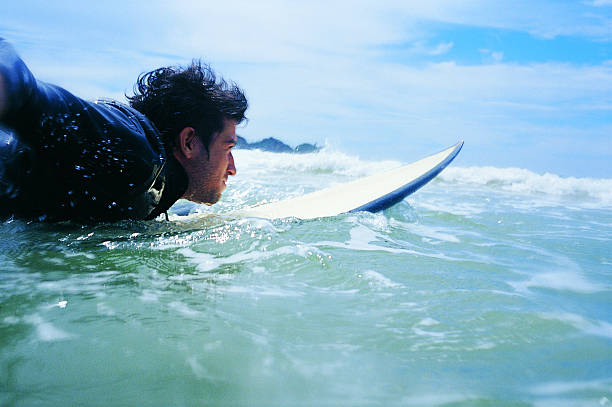
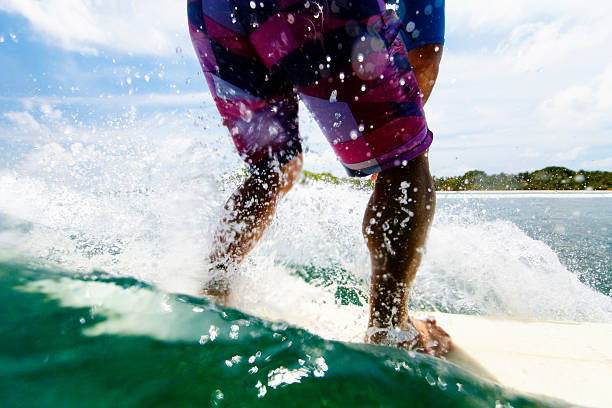
You paddle out through the channel, arms burning, lungs heaving salt air, and you feel it before you see it. That shift in the horizon. A dark line that swells like the deep inhale of a sleeping giant. The lineup goes quiet except for the chatter of fins and the creak of waxed boards. Then someone yells, “Outside set!” and every set of eyes locks onto the pulse. This is where the real language of surfing starts. Not in textbooks or Instagram captions, but in that moment when a wave stands up, throws its lip, and creates a space that changes everything. In surfer lingo, we call that wave hollow. But describing an epic wave isn’t just about one word. It’s about a whole vocabulary that separates the groms from the old salts, the kooks from the chargers.
When a wave is truly epic, we say it’s gnarly. But gnarly carries baggage now. A backside air reverse that lands on the flats can be gnarly. A wipeout that snaps your leash and sends your board to the rocks is gnarly. No, for the wave itself, the real descriptor is barrel. It is the ultimate wave. It is the reason we paddle out at dawn when the water is cold and the wind is offshore and the coffee is still sitting in the thermos. A barrel is a wave that folds over itself, creating a hollow chamber that a surfer can tuck into, if they’re brave enough and lucky enough. Some call it the green room, some call it the pit, some just call it the tube. But everyone agrees that getting barreled is the closest thing to flight that a human can experience without leaving the ocean.
The depth of the barrel determines how we talk about it. A shallow, grinding barrel that pins you against the sand is called a slab. Places like Teahupo’o, Shipstern Bluff, and The Right in Western Australia are slab territory. These waves don’t peel gently or offer you a shoulder to cruise on. They hit shallow reef or sand, suck the water off the ocean floor, and then detonate like a jaw-clenched punch from the sea. Describing a slab wave requires a whole new set of terms. You might hear a surfer say the wave was “on the boil,” meaning it was so shallow that the bottom of the wave looked like boiling water. Or they might say it was “LED,” which stands for Life Endangering Dog, a wild term for a wave that is not just heavy but malicious.
Then you have the macking waves. Macking is a classic term for waves that are not just big but powerful, moving with a kind of relentless authority that makes you reconsider your choice of hobby. A macking wave might not be a perfect barrel, but it will have a steep, pitching face that throws huge amounts of whitewater. When you drop into a macking wave, you are committed. There is no escape hatch, no casual fade to safety. You either make the bottom turn and find the exit, or you eat a washing machine cycle of foam and saltwater that rearranges your sense of up and down.
But epic waves can also be described by their shape. A clean, peeling wave that offers a long, rideable wall is called a point wave or a point break. Think of that dreamy left at Jeffreys Bay in South Africa or the perfect right at Rincon in California. These waves are not always barreling, but they are epic in a different way. They offer time. Time to carve, to hit the lip, to try a cutback that bleeds speed and then re-enters with style. When a surfer says a wave is “glass” or “glassy,” they mean the surface is smooth as a mirror. No bumps, no wind chop, just a liquid wall that invites you to draw lines across its face. That is its own kind of epic.
We also use terms like “set” to describe the pulse of the ocean. The set is a group of larger waves that come in a sequence. A clean-up set is the biggest wave of the cycle, the one that clears the lineup of anyone not paying attention. If you see a clean-up set coming and you aren’t deep enough, you get washed. But if you are sitting on a bigger board, in the right spot, you might paddle for it and find yourself dropping into something that makes your heart stop. That wave, you will talk about for days. You might even name it, in a way. Surfers remember waves the way fishermen remember fish. The wave that got away, the wave that gave you the barrel of your life, the wave that held you in the pit so long you thought you were underwater for a full minute.
Describing epic waves also requires a feel for the ocean’s mood. A wave can be “thumping” when the swell energy is concentrated and heavy. It can be “sloppy” when the swell is disorganized. It can be “tacky” when the water surface is sticky with humidity, or “oily” when the ocean is flat calm with just the faintest ripple. When the wind is offshore, pushing up the wave face, the wave stands taller and the barrel holds a cleaner shape. That is the holy grail. When the wind shifts onshore, the wave crumbles and the peak falls apart. You can hear surfers complain about a “windy” day with the same tone a pilot uses to talk about turbulence.
All of this language is a badge of understanding. It is how we connect to the ocean and to each other. When you paddle out and hear someone say, “That last set was absolute butter,” you know exactly what they mean. The wave was smooth, long, forgiving, and beautiful. When you hear, “That wave was a spit roast,” you know the barrel was so tight and hollow that it blew a jet of water out the end. That is the highest compliment a wave can receive. It means it gave you the tube and the curtain so clean that the ocean itself applauded.
In the end, describing epic waves is about capturing a feeling that words alone cannot hold. But we try anyway. We try with every term we have, from macking to slab, from glass to barrel, from LED to butter. Each word is a ripple. Each phrase is a story. Some are still being written.