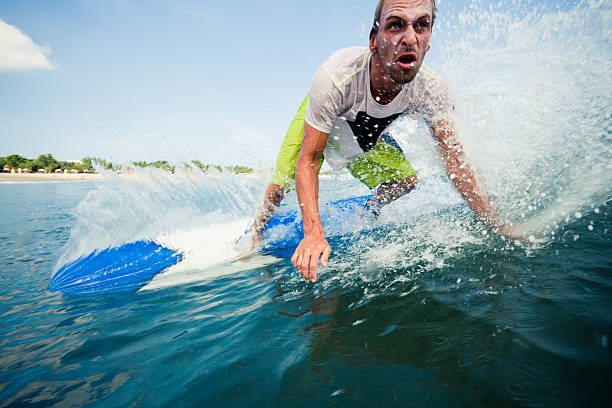
You’ve seen the clips. A surfer drops into a slab, disappears behind the curtain, then comes flying out with a spray so thick it looks like smoke. They hit the lip with a crack that echoes down the beach, and suddenly they’re above the wave, spinning and grabbing rail like it’s no big deal. You think, “Wow, that air was insane.“ But what you’re really watching is a perfect bottom turn doing all the heavy lifting. The bottom turn is the mother of every maneuver in high-performance surfing. It’s the foundation that every pro surfer worships, even if they don’t say it out loud. Without it, your carves are shaky, your snaps are weak, and your airs are just hopeful ollies. It’s time to give that humble arc at the bottom of the wave the respect it deserves.
When you paddle into a wave and drop down the face, the bottom turn is your first real decision point. That critical moment where gravity hands you a ticket to speed and you choose what to do with it. The best surfers in the world treat the bottom turn like a silent conversation with the wave. They compress their bodies, bending knees and dropping hips, as they hit the trough. Their eyes are not on their feet, not on the board, but locked on the spot in the lip where they intend to go. That’s the secret: the bottom turn is all about intention. Your weight shifts to the rail, the fins dig into the water, and the board bends through a tight arc. The wave pushes back, loading up all that potential energy like a slingshot. Then you release.
For carving, that release is smooth and drawn out. You extend your legs, push through your back foot, and let the board rise up the wave face. The key is to maintain pressure on the rail through the entire arc. If you let up, the board will flatten out and you’ll lose all that precious speed. A proper carve is not a turn; it’s a flowing, constant adjustment of angles. Think of drawing a perfect semicircle in the water, but with your whole body involved. Your front arm leads the way, your rear arm stays relaxed but ready. As you come off the top, you weight the inside rail again and the board naturally wants to come back down for the next bottom turn. That rhythm, bottom to top, bottom to top, is the heartbeat of surfing. Every carve you’ve ever admired in a video is just that rhythm made visible. The speed you’ve built from that bottom turn is your currency. Spend it wisely on the face, never letting it stall out.
Now let’s talk airs. Because the bottom turn is where airs are born. When you see Guy Sato or John John Florence soaring above the lip, watch their bottom turn closely. It’s not just a turn; it’s a violent, explosive unloading of every ounce of speed they’ve built. They go into the trough deeper, they compress harder, and they drive up the face with such intention that the wave itself seems to throw them skyward. Think of the bottom turn as the loading wind-up in baseball; the harder you wind up, the farther you can hit that ball. The critical difference between a carve and an air is the moment at the lip. In a carve, you’re still on the rail, tracing that arc. In an air, you’re abruptly releasing all that tension. As the board hits the peak, you stomp through your back foot while simultaneously lifting your front knee and rising up. The fins unload, the board pops, and suddenly you’re weightless. That “pop” is not a trick you add from your legs alone; it’s the stored energy of a proper bottom turn being released all at once.
Most surfers who fail at airs don’t have an air problem; they have a bottom turn problem. They’re too worried about getting airborne that they forget to commit to the bottom. They stall, they hesitate, they look down at the foam ball. That’s a recipe for a crunchy closeout. Instead, you need to fully commit to that bottom turn as if you were doing the biggest carve of your life. Then, at the last possible millisecond, you change your mind and pull upward. The wave will do the rest. Remember to tuck your knees and stay compact in the air. And when you land, land on that same rail you established in the bottom turn, ready to connect it all back to the pocket. So next time you paddle out, forget about the flashy stuff for a while. Spend a session just doing bottom turns. Feel the compression, feel the rail, feel the release. Make them smooth, make them aggressive, make them second nature. Because when the waves get hollow, when the section is pitching, and you need to either carve a deep, arcing turn or huck yourself into the stratosphere, it all comes back to that one move. The bottom turn is not just the start. It’s everything. Go practice it. Your airs and carves will thank you.