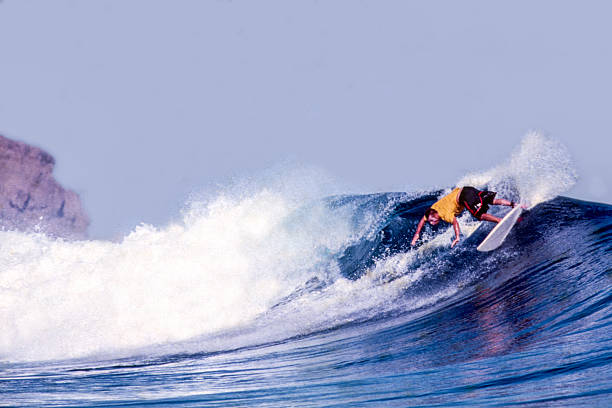
Every surfer who has ever paddled out with a shred of ambition dreams of that moment when the world goes quiet and a liquid cathedral closes over their head. Getting spit out of a barrel is the holy grail, the single most consequential achievement in our sport. But here is the real truth: getting in is where the magic lives or dies. You can have the best board under your feet, a picture-perfect sandbar, and a pulse of swell that looks like a postcard, and still end up on the wrong side of the lip if you do not know how to find the slot.
The slot is not a physical location you can see with your eyes alone. It is a feeling, a reading of the wave’s energy in the milliseconds before the whole thing stands up and throws. When you are dropping in on a pitching wave, your entire focus narrows to a single, liquid point where the face of the wave meets the cascading curtain of falling water. That point is the slot. It is the tiny gap between where the wave is standing up clean and where the lip is about to detonate. To find it, you have to stop thinking and start sensing.
The first thing to understand is that the barrel does not begin at the bottom of the wave. It begins at the top, in the moment you commit. As you take off, you are not just racing down the face; you are reading the trajectory of the lip. Is it pitching straight out like a balcony, or is it curling over you with a horizontal trajectory? The best barrels, the ones that let you live, have a lip that throws out ahead of the wave’s base. You want to position your body so that when you bottom turn, you are not aiming at the foam ball but rather aiming slightly deeper, toward the part of the wave where the face is still green and waiting. This is your entry angle.
The common mistake is to turn too hard and too soon. Novices crank a bottom turn with all their might, hoping to get under the falling lip, but that usually sends them straight into the soup or, worse, stalls them out so they get drilled from above. Instead, you want a smooth, arcing bottom turn that lets you maintain speed while directing your trajectory slightly up the face, almost parallel to the wave’s direction of travel. You are not trying to get under the barrel yet. You are trying to get into a position where the barrel can wrap around you. Let the wave do its work. If you force it, the wave will win.
As you slide up into that pocket, your eyes become your best tool. Do not look at the lip crashing in front of you. Look deeper, toward the exit or at the very least into the green part of the wave ahead. Your body will follow your eyes. This is where the term “stall and tuck” becomes real life. Once you feel the lip starting to throw over your head, you need to subtly stall. A tiny shift of weight onto your back foot, a slight straightening of your front leg, or even a gentle drag of your inside hand on the face can slow you down just enough for the wave to catch up and encase you. It is a paradox: to go faster through the barrel, you sometimes have to slow down first.
Then comes the tuck. You compress your body, lowering your center of gravity almost to the deck of your board. Your head goes down, your shoulders round forward, and your arms pull in tight. You become as small as you possibly can. The board is now just a platform beneath you, and you are riding purely on instinct, feeling the water beneath your rails and the roar above your ears. In that moment, the slot is no longer something you find. It is something you are. You have surrendered to the wave’s geometry.
The real mastery of the barrel entry comes from understanding that every wave has a unique slot. A quick, hollow reef break like Pipeline will give you a slot that is narrow and vertical, demanding a late drop and a sudden, violent tuck. A slower, sand-bottom point break will offer a wider, more forgiving window where you can cruise in with more flow. The slot reveals itself to those who paddle patiently, who watch sets roll through, and who commit without hesitation when the moment arrives. In the end, finding the slot is not about technique alone. It is about trust. Trust in your board, trust in the wave, and most importantly, trust in yourself to hold that line when the whole world goes dark.