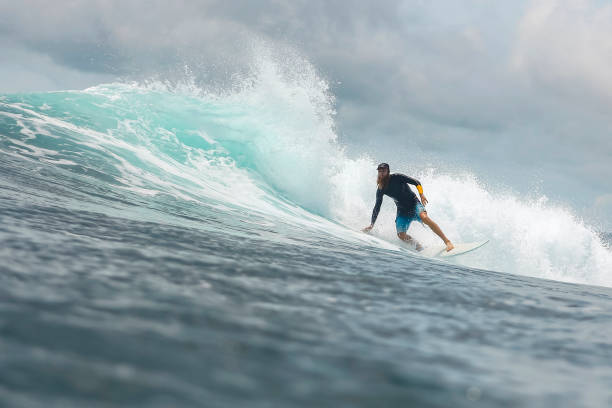
There’s a moment every surfer knows when the wave pitches and the world goes silent except for the hiss of spray and the rumble of the lip. The green room opens up like a cathedral made of ocean, and you’re inside it, flying through a space that ain’t meant for humans. Shaun Tomson didn’t just ride that space. He mapped it, carved his name into its walls, and showed the rest of us that the barrel isn’t just a place to pass through. It’s a place to think, to breathe, to become.
Back in the early seventies, the North Shore was a different animal. Guys were already charging Pipeline, but most of ’em were just hoping to survive the drop and milk a short, sketchy tube before getting pounded into the reef. Tomson showed up from Durban, South Africa, with a style that was all his own. He didn’t just get barreled. He got deep, so deep that the lip was peeling over his head and feet like a slow-motion waterfall. He made backside tube riding look like poetry, threading the needle on waves that would eat lesser mortals for lunch. His 1975 ride at Pipeline, the one that graces the cover of Surfer magazine, became proof that a human could negotiate the most treacherous section in the world with absolute control.
But Tomson’s genius wasn’t just physical. It was mental. He understood that surfing a machine like Pipeline requires a level of commitment that borders on the irrational. You can’t hesitate. You can’t half-commit. You have to look at the wave, calculate the steepness of the drop, the thickness of the lip, the shallow reef below, and then make the call — commit fully or pull off the wave and be safe. Tomson chose commitment, again and again, and he did it with a calm that seemed almost supernatural. He talked about the “inner barrel” as a metaphor for that state of mind where fear and excitement merge into pure focus. When you’re inside the wave, there’s no room for doubt. There’s only the line, the speed, and the light at the end of the tunnel.
What made Tomson a pioneer, though, is that he turned tube riding into a science of subtle adjustments. He was one of the first to ride with his back hand trailing the face, using it not just for balance but as a rudder, a way to feel the water and steer through the pocket. He developed a style that was low and compact, tucking his body into a crouch that kept his center of gravity right where it needed to be. He learned how to read the wave’s telltale signs — the suck, the draw, the moment when the wave is about to throw — and he used that knowledge to position himself perfectly. Modern tube riding, from Kelly Slater to John John Florence, owes a debt to Tomson’s early lessons in timing and trajectory.
Beyond the technique, Tomson’s legacy is one of soul. He never treated surfing as a mere sport. For him, it was a spiritual practice, a way to connect with the raw power of the ocean and with something deeper inside himself. He wrote books like “Surfer’s Code” that lay out twelve simple principles for living, each one drawn from his years in the lineup. Those principles — passion, courage, humility, stoke — they weren’t just words. They were tools for surviving both the big waves and the daily grind. When you watch old footage of Tomson gliding through a flawless Backdoor barrel, you see a man who has found his place in the universe. He’s not fighting the wave. He’s dancing with it.
The trouble with tube riding today is that it’s become so professionalized, so focused on scores and aerials and social media clips. But Shaun Tomson’s approach reminds us that the barrel is still the ultimate test of a surfer’s relationship with the sea. You can’t fake being deep. You can’t CGI your way through a hold-down. The ocean will always tell the truth. And Tomson, more than anyone, taught us to embrace that truth with open arms and a steady heart.
So next time you paddle out on a day when the swell is pumping and the sandbar is spitting, think about the little South African grom who grew up to define the art of getting tubed. Think about his calm, his focus, his absolute faith in the line. Then take that drop, tuck low, and let the wave swallow you whole. That’s where the magic lives. That’s the inner barrel.