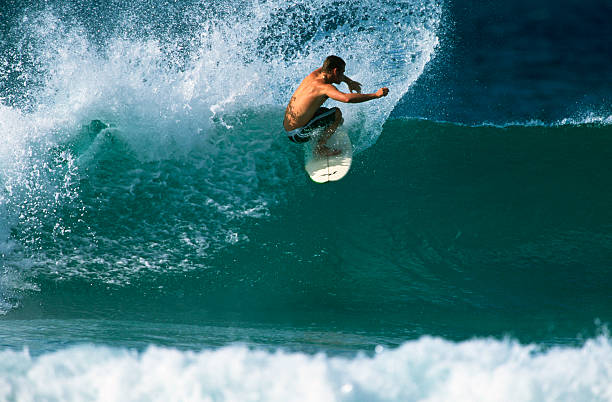
You’re sitting out in the lineup on a glassy morning, ankle-deep in sea foam, watching for that next set to roll in. The sky is pink, the water is sparkly, and it feels like the world is exactly how it should be. Then you look down between your board and your leash, and there it is: a tiny speck of neon green floating like a piece of ocean confetti. Not a fish, not a weed, not a bit of shell. It’s a microplastic. And it’s not alone. Look closer and you’ll see dozens of them, drifting along the surface like the ocean’s got a bad case of dandruff. Welcome to surfing in the twenty-first century, where the deepest, cleanest, most remote breaks from Malibu to Mentawai are packing invisible trash.
For those who haven’t been paying attention to the science reports, microplastics are minuscule fragments of plastic smaller than a grain of rice, broken down from larger debris or manufactured as tiny pellets, fibers, and exfoliating bits. They come from your polyester rash guard, your car tires, your discarded water bottle that spent twenty years tumbling in the sun, and millions of synthetic fibers that shed off your clothes every time you wash them. They flow out of rivers, out of sewer outfalls, out of the air itself, and settle into the saltwater like a nasty fog that never lifts. You can’t see them from the pier. You can’t screen them out with a camera filter. But they’re there, everywhere, from the shorebreak at your local beach to the middle of the Pacific where the water looks like glass for a thousand miles.
As surfers, we are the ocean’s canaries. We take a literal faceful of sea spray with every duck dive. We swallow seawater every time we wipe out on a closeout. We sit for hours with our legs dangling in the foam, letting the surf soak through our wetsuit seals. That means we’re not just witnessing this mess from the sand — we’re consuming it. Studies have found microplastics in shellfish, in table salt, in bottled drinking water, and even in human blood. For a dedicated surfer who spends two or three hours in the water a day, the exposure rate is off the charts. You might be sipping a few thousand particles of polyethylene with every clean-up set that smothers you. Doesn’t that just sound delicious?
But here’s the part that gets a little too real. We can’t stand fully up on our high horse about microplastics when the surf industry itself is part of the problem. Your trusty, high-performance shortboard? It’s likely made of polyurethane foam, fiberglass, and polyester resin — all plastic-based materials. Your wetsuit? That’s neoprene, a synthetic rubber that sheds tiny particles every time you stretch and scrunch it. The wax that keeps your board grippy? Yeah, usually full of synthetic additives by now. Even your leash, your board bag, and the fins in your board are all molded plastic. That gorgeous board you rode into your first barrel is quietly leaving a trail of invisible crumbs as it flexes and bends. Every ding, every repair, every time you catch a rail on a rock and scrape off a layer of foam — you’re adding to the same microplastic soup you’re paddling through. Ouch.
Here’s the stoking part, though. Surfers have always been a crew that rides the wave of change, whether it’s fashion, music, or environmental activism. We’re the ones who formed the Surfrider Foundation and pushed the Clean Water Act along the California coast. We’re the ones who show up by the hundreds on a Saturday morning with grabbers and buckets, picking up bottle caps and straws after a big swell. And now a whole new wave of sustainable surf gear is breaking. Eco-friendly board blanks made from recycled foam, bio-epoxy resins from plant-based sources, wetsuits made from natural rubber and algae, surf wax from organic beeswax, and board bags sewn from reclaimed fishing nets. It’s not all perfect yet, and some of it rides differently, but the stoke is real because the direction is right.
The big battle, though, isn’t just about what we buy. It’s about policy and power. When surfers like us start talking loud about single-use plastics, about mandatory microplastic filters on washing machines, about extended producer responsibility that forces companies to pay for the cleanup, the wave starts to build. We can sign petitions, we can write to our local county board, and we can vote for leaders who see the ocean as a living thing rather than a dumping ground. We’ve got the numbers, the passion, and the stoke to make that drop. Every session brings us face to face with the truth. The ocean is our cathedral, our playground, our reason to drive three hours with a leaky roof rack in the pouring rain. And the ocean is drowning in plastic.
So do this for the next dawn patrol. Fill up a reusable bottle, skip the single-use sunscreen that contains microbeads, wear natural fiber clothes when you can, and give your board a little love so it isn’t shedding bits. When you paddle out, spend a couple minutes picking up any trash you see before you get in the water. Not because you own the place, but because you’re part of the tribe that promises to protect it. The ocean doesn’t need a perfect environmentalist. It needs a surfer who shrugs, grabs a floating plastic bottle, and says not on my watch. Bury your fins in the sand, look at that horizon line, and remember that the cleanest waves are never just about swell charts and winds. They’re about justice. They’re about health. They’re about keeping that water so clean you can get pitted without catching a side of Styrofoam with your breath. Stay glassy, friends. The ocean’s counting on us to pull into this one and ride it all the way to the beach.