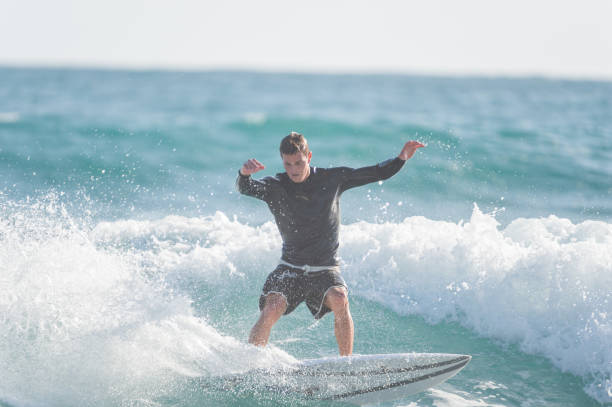
There’s a moment that every wave rider lives for, that split second when the horizon starts breathing different and the water goes all nervous and electric. You paddle out on a day that’s just a little too big for comfort, and suddenly you see it — a set stacking up like a wall of ancient greed, jacking up fast and feathering in the offshore breeze. In that moment, you don’t say “nice wave.” You say “holy sh—, that thing is going to detonate.” And that’s where the real language of our tribe kicks in. We’ve got a whole vocabulary for waves that demand respect, words that have been shaped by decades of salt, foam, and near-death experiences. It’s not just about telling your buddy a wave is big. It’s about describing the way it shakes the ocean floor, the way it throws its lip with murderous intent, and the way it makes your thighs tremble before you even take a stroke.
First off, a wave that’s firing on all cylinders is “pumping.” That doesn’t mean a little fun-sized ripple. A pumping day means the swell has arrived with serious intent, the sort of groundswell that has been born in a hurricane twelve hundred miles away and traveled with pure, unfiltered energy. When you paddle out under a pumping sky, the sets are rolling in like freight trains with no schedule, and the lineup feels less like a playground and more like a war zone. But pumping is just the opening statement. The real poetry begins when you get into the shape of the beast itself.
A wave with real muscle and steep, intimidating face is often called “hollow.” Hollow is the gold standard. That means the wave is pitching out, creating an empty tube that could swallow you whole if you hesitate. But we don’t stop at hollow. Oh no. We say “shacking,” which is when the lip is especially thick and the barrel is legitimately dark enough to make you wonder if you’ll see daylight again. A shacking wave is a wave that barks, a wave that throws its own personal ceiling over your head. And if it’s doing that violently, with real aggression, then we call it “heavily.” When you hear a surfer say “that wave was firing hee-yoo-jee” — okay, that’s just excited talking. But when they say “it was absolutely spitting,” that’s the highest praise. Spitting means the back of the barrel is exploding in fine droplets, like the wave is exhaling a lungful of sea mist. You can’t fake that. You can’t photoshop that. Spitting is the mark of a truly epic, hollow beast.
Now, size. We don’t use boring numbers. We use “overhead,” “double overhead,” “triple overhead,” and then we get loose and say “it was a bomb.” A bomb is that one monstrous wave in a set that makes the others look like ankle biters. When you see a bomb approaching, the whole lineup starts paddling frantically, because you know that wave has a personal grudge. Some of us call it a “gorilla” — a huge, unruly, hairy wave that’s all power and no manners. Others say “the elephant” or simply “the big fella.” But the classic, most universal term for a wave of serious consequence is “gnarly.” That word carries so much weight. A gnarly wave is not just big, it’s gnarly in texture — bumpy with steep drops, shifting peaks, maybe a side-shore wind that makes the face look like a thousand broken mirrors.
We also describe the source of the wave’s power. A “groundswell” is the holy grail — long-period energy that has traveled across open ocean, giving waves that deep, orderly, heavy push. In contrast, a “windswell” is choppy and sloppy, and we usually don’t bother calling that epic. When the swell lines up perfectly with the reef or sandbar, we get a “clean” wave, which means the surface is like glass with no cross-chop. And when the offshore wind is blowing right, the wave stands up tall and proud, and we call that “walled up.” A walled-up wave offers a long, steep face that you can carve for days, but it can also be intimidating because there’s no soft shoulder to escape to. You either commit to the barrel or you eat the foam.
Every surfer has their own threshold for what qualifies as epic. My buddy Swede calls any wave that makes his knees knock a “pucker brush.” I had a mate who called a hollow twenty-footer a “titty-ripper,” which I won’t repeat at dinner. But the beauty of surf lingo is how fluid and personal it is. What matters is that when you’re sitting out back and you see a set coming that rearranges your stomach, you’ve got the words to describe it. And those words are not just descriptors — they’re respect. They’re humility. They’re a prayer that you’ll be worthy of that wave’s power, and a reminder that the ocean is always the one really in charge. Because at the end of the day, no matter what you call it, an epic wave is a gift and a threat, and we love it for both.