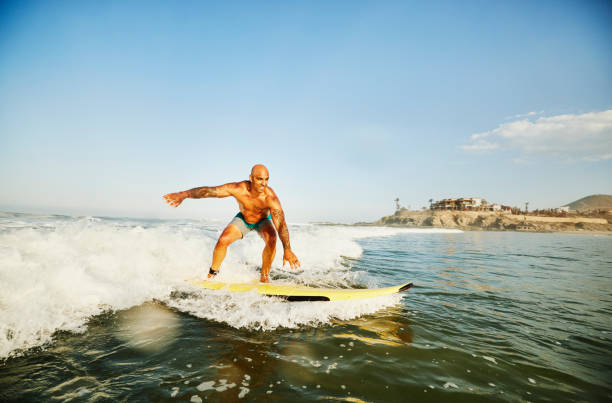
You paddle out past the shorebreak, past the foamies, past the wobbly beginners trying to stand up on those soft-top logs, and you know you’ve entered a different kind of water. Out here, in the lineup, there’s an unspoken hierarchy. Eyes watch the horizon, but they also watch each other. And when a wave rears up and one surfer drops in, bottom turns hard, and drives through the section with a spray that hits like a shotgun blast, the others nod. That, my friend, is a ripper. The word itself is surf slang that’s been around since the golden days of the longboard era, but it’s never gone out of style. A ripper isn’t just someone who can stand on a board. A ripper is the surfer who makes the wave look like it was built for them, who carves with precision, who pulls into barrels that would swallow anyone else, and who walks away with a grin that says, “Yeah, that was pretty good.”
To earn the title of ripper, you need more than a flashy turn or a big air. You need a deep, almost intuitive connection with the ocean. A true ripper reads the water like a book: the pulse of the swell, the shifting sandbars, the way the wind kisses the face of the wave. They know when to paddle hard, when to stall, when to fade back to set up a better angle. Every move is deliberate. A bottom turn isn’t just a bottom turn—it’s a way to load the rail, to feel the water compress under the board, and to launch up into the pocket with raw speed. Their cutbacks are tight, almost violent, a slash of the tail that throws a curtain of whitewater. Their floaters are smooth, gliding over the lip like it’s butter. And when they go for a barrel, they don’t just stick their head in and pray. They position their body to tuck, to see the light at the end, to ride that green cathedral for as long as the wave allows.
Part of being a ripper is the attitude. Not the cocky, arrogant kind that burns other surfers or drops in on everyone. That’s not ripping, that’s just being a kook with a mean streak. Real rippers have stoke—they’re stoked on the waves, stoked on the ocean, stoked to see someone else get a good one, too. They share the peak. They wait their turn. And when they do take off, they make it count. That’s the respect that builds a reputation. Out here, word travels faster than a south swell: “Did you see Mick today? He was ripping.” That means something. It means he had the speed, the style, the flow, and the grace to make everything look effortless even when the conditions were gnarly, choppy, and closing out.
The lingo surrounding rippers is part of the whole surf culture tapestry. You’ll hear guys on the beach say, “He’s absolutely shredding,” or “She’s charging,” or “That was a gnar-gnar ride, bro.” But “ripper” is a specific badge. It implies a high level of competency across all aspects: paddling, duck-diving, wave selection, and wave artistry. A surfer who is “ripping” is surfing at their peak—sometimes above it. It’s the difference between catching waves and owning them. Think of someone like Kelly Slater in his prime, carving a wave at Pipeline with no wasted motion. Or think of a local legend at your own break, the one who shows up at dawn, wears a faded wetsuit, and still outsurfs everyone half his age with nothing but backhand snaps and a deep, velvety style. That’s a ripper.
The beauty of the term is that it’s not exclusive to pros. You can be a ripper at a three-foot beach break just as easily as at a ten-foot reef. It’s about mastery, not machismo. It’s about reading the wave, timing your moves, and walking away with a feeling that you’ve done something special. That’s why the word has stuck around so long—it’s simple, it’s honest, and it describes a surfer you want to watch, and maybe a surfer you want to become.
So next time you’re out in the water and you see someone drop in, drive down the line, and throw a spray that catches the sun like a diamond, give them a nod. They might be a ripper. And if you’re the one doing the ripping—if the wave feels like an extension of your own body—then you know you’re living the dream. Paddle back out, catch another, keep the stoke alive. That’s the code. That’s surf lingo at its finest.