There’s a moment every surfer knows, whether you’ve been at it for one season or twenty, when your arms are burning, your lungs are heaving, and the wave you’re chasing feels like it’s mocking you from a hundred yards out. You dig hard, throw your shoulders into every stroke, and still the horizon barely inches closer. That’s the moment most surfers start fighting the ocean instead of working with it. And that’s the exact moment paddling stops being just about strength and starts being about rhythm, about understanding the subtle conversation between your body and the water.
Paddling to perfection isn’t about horsepower. It’s about flow. The ocean doesn’t care how many pull‑ups you can do. She cares how you read her pulse, how you sync your stroke with the swell’s breath, and how you conserve every ounce of energy for the one wave that matters. Think of paddling like a slow, deliberate dance instead of a desperate sprint. The best paddlers in the lineup look almost lazy. They don’t thrash. They glide. They know that the fastest way across the water is often the smoothest, not the most aggressive.
Start with your hands. A common mistake is to cup your fingers tight and slash at the water like you’re trying to chop wood. That creates turbulence and drag. Instead, keep your fingers slightly apart, relaxed, as if you’re gently scooping a handful of silk. Enter the water with your hand at about the angle of a shallow plane, thumb first, and pull through in an S‑curve. That S‑curve engages your lats, your core, and your back muscles—the big engines—instead of just your puny shoulders and biceps. Each stroke should feel like you’re grabbing a handful of water and throwing it past your hip, not punching the surface.
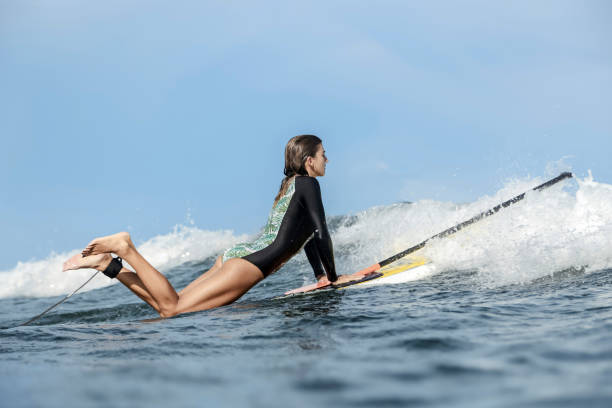
Your head needs to be up just enough to see where you’re going, but not so high that your chest caves in and your lower back arches. That posture turns you into a human sail, catching every bit of wind and chop. Keep your chin hovering an inch above the deck. Your weight should be centered over the stringer, balanced, with your hips slightly forward. When you lift your head to scan for sets, do it with your eyes, not your whole spine. Every inch your chest rises is a inch the wave has to push you backward.
Now here’s the secret that separates the frothers from the experienced: the paddle stroke should never be frantic. Use a long, steady cadence. Count your strokes if you have to. Three long pulls, then a short glide. Breathe out on the pull, breathe in on the recovery. This rhythmic breathing does two things—it keeps your heart rate from spiking into panic territory, and it syncs your body with the ocean’s own pulse. Watch the water in front of you. When you see a set wave approaching, don’t start paddling like a maniac. Gauge its speed, angle your board, and time your burst. Speed is not constant. It’s a weapon you deploy in short, powerful surges.
The paddle‑out itself is an art form. Instead of fighting every whitewater wall head‑on, learn to duck dive or turtle roll with grace. A deep, clean duck dive—where you push the nose under, drive your knee into the deck, and let the foam pass over your back—is worth a thousand desperate strokes. For those on longer boards, the turtle roll is your best friend. Grab the rails, flip upside down, let the wave wash over the bottom of your board, then roll back up in time for the next lull. The key is not to panic under the foam. Stay relaxed, hold your breath, and let the ocean tell you when it’s safe to surface.
Paddling also means reading the lineup. Don’t just stare at the horizon; feel the bumps under your hull. The ocean talks through the board. A sudden lift means a swell is about to hit. A flatness means it’s time to reposition. Learn to paddle not just forward, but sideways, adjusting your angle so you’re always in the pocket when the wave picks you up. That means paddling a few strokes toward the peak, even when you’re already tired. The extra effort saves you from a closeout or a late drop.
And remember, paddling is meditation. The ocean doesn’t reward anxiety. The best surfers I’ve ever watched—the ones who seem to catch every wave without ever looking rushed—they paddle like they’re breathing underwater. Their strokes are calm, purposeful, and efficient. They’re not trying to outmuscle the sea. They’re learning her rhythm and making it their own. So next time you slide off the sand, take a deep breath, drop your shoulders, and let your arms find that smooth, endless stroke. Paddle like you’ve got all day, because you do. The wave will come. It always does.