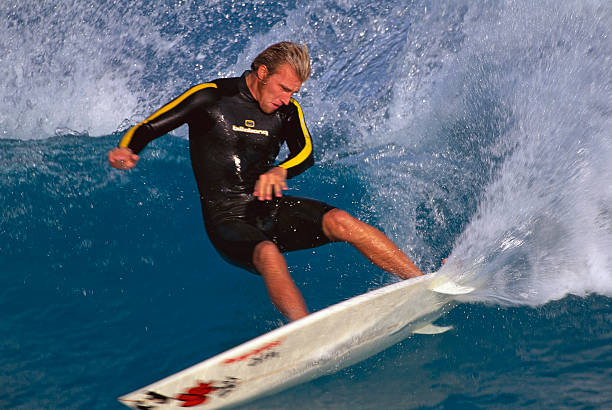
There’s a certain kind of stoke that hits you when the air gets warm and the water starts to glass off. You look at the horizon, and you can almost hear that twangy guitar riff from The Endless Summer echoing in your skull. That movie, man. That movie didn’t just capture surfing—it rewired the whole damn dream. Before it dropped in 1966, the average beachgoer thought surfing was some exotic tribal thing that happened only in Hawaii or maybe a few fringe spots in California. Then Bruce Brown packed up his Bolex camera and two young rippers, Mike Hynson and Robert August, and chased the sun around the planet like a couple of golden retrievers with boards under their arms. And in doing so, he turned surf culture into a global language.
What makes The Endless Summer so special isn’t just the waves—though the waves are absolutely absurd, spinning and hollow in places most mainlanders never knew existed. It’s the vibe. Brown didn’t shoot a competition. He didn’t film a lineup showdown or a world tour event. He made a road movie, a buddy flick, a stoke-filled travel diary that just happens to feature some of the most perfect peeling walls ever captured on 16mm. The plot is beautifully simple: the guys pack their boards in the Northern Hemisphere summer, then chase the warm-water swell to the Southern Hemisphere’s winter. They hit Senegal, Ghana, South Africa, Australia, New Zealand, Tahiti, and Hawaii. Everywhere they land, the locals are initially wary or straight-up puzzled, but once those boys start drawing lines on waves that nobody’s ever ridden before, the whole frozen smiles melt into pure aloha. That’s the universal truth the film nails—surfing isn’t a sport you watch. It’s a feeling you catch.
The editing is a trip, too. Brown’s voiceover is dry and witty, like a cool older cousin explaining the world to you while he’s got a cold beer in one hand and a camera in the other. He doesn’t take himself too seriously. He calls a wipeout a “clambake” and laughs through a slow-motion sequence of Hynson getting pitched over the falls like a ragdoll in a washing machine. That lightness is what separates The Endless Summer from every surf flick that tried to copy it. It doesn’t pretend surfing is some deep mystical calling, even though for many of us it totally is. Instead, it shows you the pure, goofy, uncomplicated joy of getting covered up in a barreling left in a country you can’t even pronounce. It makes you want to book a flight immediately.
On the technical side, Brown did things that were practically unheard of. He used a waterproof housing he built himself, shooting from the water and from a helicopter, capturing angles that made the waves look like living cathedrals. The film’s score, composed by the Sandals, is so iconic that you can hum the main riff even if you’ve never seen the movie. That twangy surf guitar became the soundtrack for an entire generation’s wanderlust. And the pacing—slow, patient, with long lulls between waves—actually builds tension better than any modern hyper-cut edit. You sit there, feet tapping, waiting for that perfect set to roll in. And then it does, and you’re grinning like a maniac.
But the biggest legacy of The Endless Summer is the way it turned surfing into a passport. After the film hit, surfers started flooding locations that had previously been unknown. Some of those spots are now crowded, yes. But back then, Hynson and August were true pioneers, showing up with no maps, no social media, just word of mouth and an open mind. They treated local surfers with respect, sharing waves and swapping stories. That’s a lesson that still rings true today. Surfing is not about claiming territory or blowing up secret spots. It’s about the shared experience—the salt in your hair, the sand in your wetsuit, the golden light of a late afternoon when the swell finally lines up perfectly and you’re just one small human on a tiny piece of the ocean’s endless dance.
So yeah, The Endless Summer is more than a classic. It’s the blueprint for every surf trip, every passport stamp covered in wax, every reckless decision to chase a storm swell across an ocean. It tells you that summer never has to end if you’re willing to stay in motion, to keep your eyes on the horizon, and to never forget that the best wave in the world is the next one you’re paddling for. Keep the stoke alive, dudes. The surf is always somewhere.