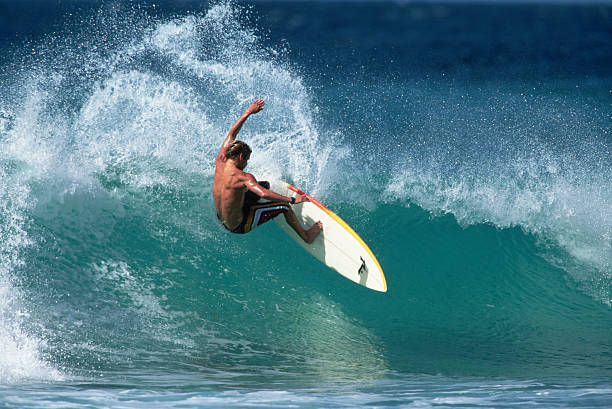
There’s a moment when you drop in and the wave stands up in front of you like a wall of moving glass, and you have to decide right then whether you’re gonna slide out the back or commit to the turn that sets up everything else. That bottom turn is the foundation of every good ride, and the real secret to making it sing isn’t just where you put your feet or how hard you lean. It’s the dance between compression and extension. Get that rhythm dialed and you’ll come off the bottom with speed, power, and the kind of snap that makes the face light up.
Think of compression as loading a spring. When you sink low, bending your knees and bringing your torso down toward the board, you’re storing energy. Your fins dig in, the rail bites into the water, and the board becomes part of the wave. That’s the moment of maximum grip, when you feel the water pressing back against you, telling you it’s ready to help you turn. But if you stay compressed too long, you stall out. You need to extend at exactly the right instant to release that stored energy and send it forward up the face.
The timing starts as soon as you hit the bottom of the wave. You’re coming down the drop, weight centered, eyes already looking where you want to go. As the board levels out, you start to compress. Drop your hips, bend your knees, and let your back arm swing low and inside the turn. This isn’t a squat—it’s a smooth, coiled descent into the pocket. Your front shoulder should stay open, leading your gaze toward the lip. The more you compress, the more you load the rail. You want to feel that rail digging a trench in the water, carving a line that connects the bottom to the top.
Then comes the extension. You don’t just stand up; you explode up and forward. Push through your back foot to drive the tail, but also lift your chest and rotate your hips toward the direction you want to go. This is where the magic happens. The board, freed from the deep compression, suddenly releases its grip and races up the face. If you time it right, you’ll feel a surge of acceleration, like the wave itself is throwing you upward. If you extend too early, you lose the rail and slide sideways. Too late, and you’ve already lost your momentum, bogging down in the trough.
The best surfers make this look effortless because they understand that compression and extension aren’t separate moves. They’re one continuous flow, a breathing cycle with the wave. Watch any footage of Kelly Slater in his prime, or John John Florence today. They don’t just bend and stand. They flow through the bottom turn like water moving through a channel. Their compression is deep but relaxed, their extension is explosive but controlled. The key is to match the timing to the wave’s own energy. A steep, hollow wave needs a faster compression and a quicker extension. A long, rolling point break lets you sink deeper and extend more slowly, using the whole face to build speed.
Another thing to keep in mind is the role of your arms. Your front arm should be pointing where you want to go, almost like a spear. Your back arm drops low during compression, then swings up and across your body during extension. This windup and release adds whip to the turn. Without the arm motion, the turn feels stiff and dead. With it, you generate extra torque that transfers through your core and into the board.
You also have to stay loose in the lower back. Tight hip flexors or a locked lumbar spine kill the range of motion. Surfing is fluid, not rigid. Imagine you’re a willow in a strong wind, bending without breaking. That’s the feel of a good bottom turn: you give yourself to the wave’s push, but you give it back with interest.
And don’t forget the exit. After you extend and launch up the face, you need to stay connected. Don’t just stand there like a statue. Start compressing again as you approach the lip, getting ready for the top turn or the cutback. Every bottom turn is a setup for the next move. If you nail the compression-extension cycle, you’ll flow from bottom to top and back down again in a continuous loop, each turn feeding the next.
So next time you paddle out, stop worrying about how radical your turn looks or whether you’re sliding out. Focus on the spring. Feel the coil, then feel the release. The wave will tell you when. Trust that, and your bottom turn will become your favorite part of the ride.