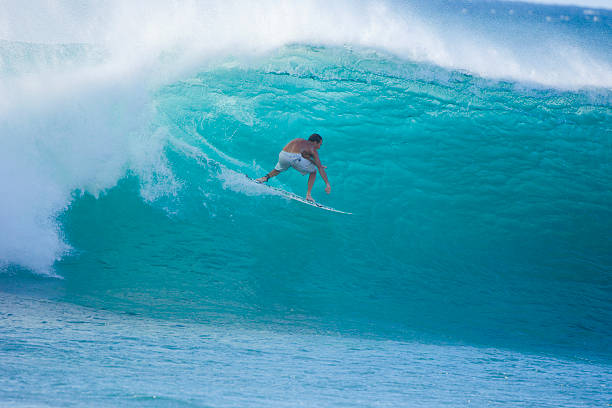
Nobody just paddles out at Waimea Bay. You earn that water. You earn the respect of the wave, the rock, the deep blue shelf that turns a humble Pacific swell into a thundering freight train of consequence. And every single surfer who has ever looked down that steep, moving mountain has done so in the shadow of one man: Eddie Aikau. He wasn’t just a big wave rider. He was the soul of the North Shore, the heartbeat of a culture that was just beginning to understand its own power.
Eddie was born in Kahului, Maui, in 1946, but his spirit quickly found its home on Oahu’s North Shore. He wasn’t the biggest guy in the lineup, but he had this quiet, powerful presence that made you stop and pay attention. He didn’t need to shout or preen for the cameras. He just surfed. And when Eddie surfed, especially at Waimea, it was like watching a prayer in motion. He had this deep, powerful style, a beautiful carve that seemed to flow from his very bones. But what truly set Eddie apart wasn’t just how he rode the wave—it was what he did when the wave tried to take you down.
It’s important to understand the era. This was before jet skis, before rescue sleds, before helicopter drops for the weirdly cold guy at the edge of the channel. When Eddie became the first official lifeguard at Waimea Bay in the late 1960s, he was it. One man. One fin. One fiberglass board. And a heart so big it could hold the entire lineup. The Bay back then was raw, unexplored in the way we think of exploration today. Waves were ridden, but the fear was palpable. The rocks at Waimea are sharp, the currents are relentless, and the wipeouts can hold you under for what feels like an eternity. But Eddie would paddle out into the chaos, pull some shell-shocked kook from the impact zone, and bring them back to shore as if it were no big deal. He saved hundreds of lives. He never lost a single person on his watch. That is not a record. That is a miracle.
But Eddie’s legacy is bigger than his rescues. He was a key figure in the Hawaiian Renaissance, a movement to reclaim the language, the dance, the hula, the connection to the land and the ocean that made his people who they were. He didn’t just surf. He lived the concept of aloha in a way that most of us only read about in brochures. Aloha isn’t just “hello” and “goodbye.“ It means love, compassion, mercy, and the breath of life itself. Eddie breathed that into every wave he caught.
Then came the Hokule’a. In 1978, Eddie joined the crew of the Polynesian Voyaging Society’s double-hulled canoe, a replica of ancient voyaging vessels meant to rediscover the old navigation paths of the Pacific. The canoe was a symbol of cultural pride, a way to prove that his ancestors didn’t just luck into finding the Hawaiian islands through a storm. They were the greatest navigators the world has ever known. But during a storm off the coast of Molokai, the Hokule’a capsized. The crew was stranded in the open ocean. Eddie, believing the authorities wouldn’t find them in time, made a choice. He took his surfboard and paddled for Lanai, nearly twenty miles away, to get help.
That was the last time anyone saw him alive. He was never found. The rest of the crew was rescued the next day by a plane, but Eddie had already disappeared into the vast Pacific. The ocean that had given him so much had claimed him in the end. But the ocean didn’t take his spirit. It just made it bigger.
Today, we remember Eddie every winter on the North Shore. The Eddie Aikau Big Wave Invitational only runs when the swell is big enough, with waves holding at least twenty feet by the buoy. It’s the most prestigious contest in surfing, not for the prize money, but for the honor of being chosen to paddle out in memory of a man who defined courage. When they blow the conch shell and you see those thirty or so surfers take off at Waimea, you know why the motto is “Eddie Would Go.“ It’s not about winning. It’s about showing up. It’s about dropping into a wave that terrifies you because you know the ocean is worth it. Eddie Aikau showed us that surfing isn’t just a sport. It’s a way to live with purpose, to carry the mana of your elders, and to never, ever back down from the swell that calls your name.