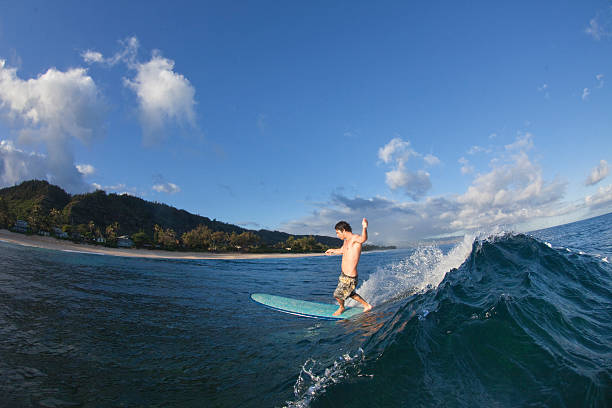
You paddle out, you sit in the lineup, you feel that pulse of energy rolling in from the deep blue, and when the set wave of the session finally stands up, you spin around, stroke hard, and pop to your feet. That first drop is pure stoke. But what separates a sloppy scramble from a truly connected ride is the bottom turn. This is the move that sets the tone for the entire wave. The bottom turn is the foundation, the anchor, the moment of truth where you either link up with the wave’s energy or get pinballed into the flats. It is, without question, the most critical maneuver in all of surfing.
Think of the bottom turn as the universe’s way of telling you that you have to go down before you can go up. You drop down the face, and for a split second, you are in freefall. Your board is pointed straight toward the trough, and your instinct might scream to turn immediately. But a good surfer knows the secret. You have to plant that rail, compress your body like a coiled spring, and let the wave’s own momentum throw you back up into the pocket. It’s the transition between the drop and the first carve. If you rush it, you lose all your speed. If you stall, you get buried by the foamball. The bottom turn is a negotiation with gravity, and you have to win that negotiation every single time.
The mechanics of a solid bottom turn are more about your eyes and your hips than your feet. You look where you want to go, down the line, toward the open face. You sink your weight into your back foot, but not too far back, because you still need to keep that nose out of the water. Your front hand reaches toward the wave’s face, and your back hand stays low, almost touching the water. That’s the stance. You drive your back knee in toward the wave, and you feel that inside rail bite into the water like a knife. The board doesn’t turn because you force it; it turns because you commit your body weight and let the fin do its job.
Surf culture has a romantic relationship with the bottom turn because it is the purest expression of power and grace combined. In the old days, longboarders would do a slow, drawn-out bottom turn, almost like a waltz with the wave, before gliding back to the shoulder. Then came the shortboard revolution of the late 60s and 70s, and suddenly the bottom turn became a radical, explosive move. Guys like Gerry Lopez and Shaun Tomson redefined what it meant to sink a rail. They would drive so deep into the trough that their shoulders nearly touched the water, and then they would unleash an arc of spray that looked like a firehose cutting through the air. That was the birth of the modern power turn.
But the bottom turn is not just about raw strength. It is about reading the wave. A steep, hollow wave demands a tighter, more vertical bottom turn. You have to plant it deep, almost at the base of the wave, and then drive straight up the face, often setting yourself up for a barrel if the wave has a proper lip. On a slower, mushy wave, you flatten that turn out, make it wider, and use the rebound to carry speed into the next section. Pros will tell you that the bottom turn is where you decide whether you get one good snap or three or four. If you nail the bottom turn, you have speed to burn. If you botch it, you are fighting for your life for the rest of the ride.
There is also a deep philosophical element to the bottom turn. It is the moment when you fully commit. You cannot half-ass a bottom turn. You either sink that rail and trust the physics, or you feather out and lose the wave. In that sense, the bottom turn is a perfect metaphor for surfing as a lifestyle. It reminds you that sometimes you have to drop all the way down to the bottom of the situation before you can rise up with any real momentum. Surfers understand this intuitively. That is why you see guys sitting in the lineup, staring at the horizon, not just scanning for a wave but mentally rehearsing that first bottom turn.
From a technical standpoint, the bottom turn also connects directly to the more advanced moves. A floater, a cutback, a re-entry, and especially an aerial all start with a strong bottom turn. You cannot do an air reverse without first generating speed through a bottom turn. You cannot get vertical in the barrel without that initial compression and drive. The bottom turn is the entry ramp to the freeway. Without it, you are stuck in the parking lot.
So next time you paddle out, give the bottom turn the respect it deserves. Don’t just drop in and flail. Focus on your weight, your rail, your line of sight. Feel the board accelerate as you hit the trough, then lean into that turn like your life depends on it. Because in a way, your ride does. The bottom turn is not just a move. It is the soul of the ride, the only thing standing between you and a wall of whitewater.