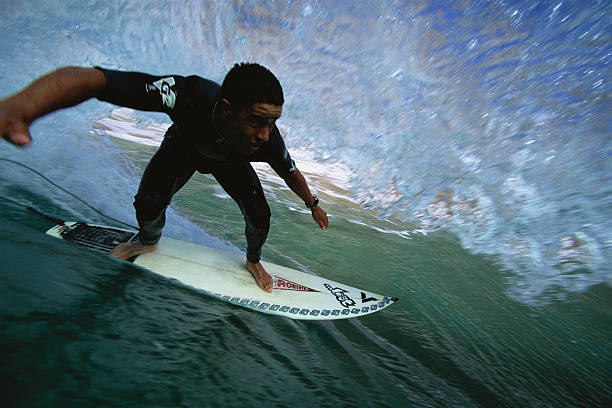
When most folks hear the word shredding, their minds jump straight to the vertical hucking of a high-performance shortboard on a six-foot keg. But out here in the lineup, there is another kind of power. It is a quieter power, a smoother power, a power that comes from finding the absolute farthest point forward you can go without losing it all. I am talking about the nose ride, and specifically the hang ten. This is riding with power in its most distilled form, a total surrender to trim.
The modern firecracker surfer might look at a traditional longboard and see a log, a cruiser, something to walk up and down, maybe to nose ride on a soft crumbling one-foot wave. But the true hang ten, the deep noseride on a wave with some push, is one of the most radical and powerful maneuvers in all of surfing. It is not about dropping in with a tail slide or wrapping a cutback so hard you blow the tail off your board. It is about static balance at the highest dynamic speed. It is about becoming a human rail, a part of the wave.
To understand the power of the hang ten, you have to understand the physics. Your board is a lever. The fulcrum is the apex of the wave, the point of most critical power, the green room of the pocket. When you walk up and your toes wrap over the nose, you are shifting your mass forward of the center of lift. The board wants to pearl. The nose wants to bury. The wave wants to eat you. The power, the real shredding, comes from finding that millimeter of trim between pearling and flying off the back, where your forward momentum perfectly matches the speed of the wave. The board hums. The fins sing a chattering song as they barely hold. Your back foot is light, maybe just resting on the pad, while your whole core is locked into the board like a figurehead on a ship of wood.
This is not a passive ride. You are constantly micro-adjusting. You shift your hips a hair forward to sink the nose deeper, stealing a few more inches. You pull your toes back to lift the nose out of a pocket that is closing down. You move your shoulders, your head, your gaze—always looking down the line to where power is coming from. This is the language of trim, and a hang ten is the ultimate vocabulary word. It is often called the cheater five, the hang five, or the full ten, and each step up in commitment is a step deeper into the wave’s energy.
The power in a noseride is also a spiritual one. When you are standing up there, ten toes dripping over the tip of a nine-foot log, you are borrowing the wave’s energy for a moment of sheer weightlessness. You are not fighting the wave. You are not even riding it. You are letting it carry you. The power is in the patience. The power is in the stillness. You have stopped moving your feet, stopped pumping, stopped clawing for speed. You have achieved a state of total equilibrium. The wave is a liquid train, and you are on the nose of the engine.
This style of riding with power demands a specific board. A proper noseriding log has a wide, blunt nose, often with a flipped or rolled rail to deflect the water. It has a deep, single fin or a center fin heavy setup, and it is usually heavy, with plenty of foam under the chest. A toothpick will not cut it. You need a hull, a sled, a board that has enough volume to support your body weight even when you are six feet up from the tail. The modern performance board is too pinched, too narrow. The nose of a true log is your canvas.
And there is an etiquette to it. When you see a guy hanging ten down a long peeling point break, you are seeing a surfer who has read the wave perfectly. He knows the exact section of the wave face where the inside pocket of the curl becomes a clean shoulder. He knows when the wave is fat enough to hold him up, and when it is hollow enough to suck the nose down. He is riding the power of the wave’s geometry as much as its speed.
We often forget in this era of air reverses that the greats of the 60s, men like Phil Edwards, Miki Dora, and the legendary Duke, defined shredding by how far forward they could get. They were charging the hardest part of the wave from the very tip of their boards. It is a humbling thing to try. You will pearl. You will eat sand. You will look like a kook, wobbling backward, arms flailing. But then, one day, you find it. The wave opens. You shuffle up. Your toes find the edge. The world goes quiet. The only sound is the hiss of the nose slicing through the unbroken part of the water. That is the power. That is the ultimate trim. That is shredding the way the ancestors intended.
So next time you paddle out, grab that log. Take a walk. Get way up there. Feel the weight of the wave under your feet. It is the oldest power trip in the book.