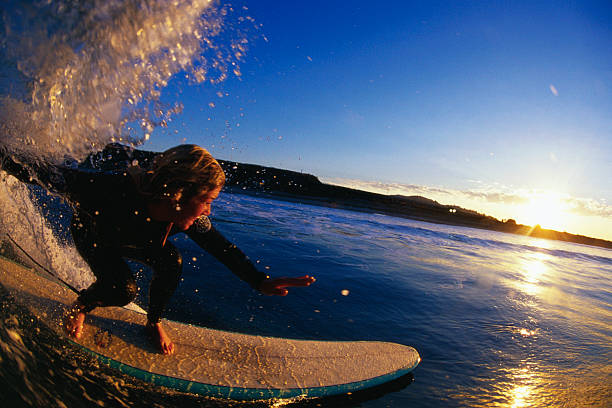
You see it every dawn patrol session. Some guys paddle like beasts, arms churning, chest heaving, foam flying off their board rails. They blow through sets, gasping for breath, and still end up on the inside, staring at the back of the wave as it pitches over their tail. Meanwhile, that little grom in the corner, the one with the sun-bleached hair and a board that looks held together by wax and hopes, barely seems to paddle at all. He sits casual, watching the horizon, takes three elegant strokes, and slides right into the green room like the ocean owes him a favor. That difference ain’t about strength, brother. That’s about reading the peak.
The peak is the heart of the wave. It’s the highest point of the face, the place where the lip first throws out its telltale spray. Everyone thinks they know where the peak is, but few actually see it before it arrives. The beginner fixates on the whitewater, chasing the broken foam. The intermediate watches the horizon for a lump. But the surfer who catches more waves than anyone in the lineup watches something else entirely. They watch the energy transfer. They watch the way the water texture changes from chaotic chop to a slick, glassy sheen. They feel the pulse of the ocean moving through the sea floor long before the wave stands up.
Here is the secret most people miss. You don’t paddle to where the wave is right now. You paddle to where the wave is going to be. That sounds simple, but it changes everything about how you spend your energy in the water. When you see a set line forming on the horizon, you need to calculate the takeoff zone roughly fifteen to twenty seconds into the future. The wave is going to jack up, steepen, and hit a certain section of reef, sandbar, or point. You need to be sitting six feet beyond that section, looking towards the shoulder, not the peak itself. If you sit directly under the peak, you are gonna get crushed by the curtain. You want to be slightly inside, angled, ready to slide into the pocket as it forms.
Reading the peak also means understanding the math of the takeoff. There is a sweet spot called the critical section where the wave is steep enough to drop you in but not so steep that it detonates on your head. That sweet spot migrates with every wave in a set. The first wave might break deeper, further up the point. The second wave might jack up faster and shift its peak thirty feet down the line. The surfer who reads the peak knows not to chase the first wave if the second has more juice. They watch the dark lines, the darker bands of water that indicate deeper channels and shallower reefs. The water turns darker green or blue over the deep spots, and lighter, more opaque over the shallow sections that force the wave to break. You want to be sitting just on the edge of that light water, adjacent to the takeoff zone.
Then there is the drop itself. When you commit to a wave, you have already made a thousand micro-decisions based on what you read in that peak. The angle of your body changes. You stop paddling early, letting the wave come to you rather than you charging at it. You pop up with your eyes locked on the section ahead, not the foam behind you. If you read the peak right, your first bottom turn finds the power source naturally. You don’t have to pump hard to catch up. The wave was already timed to your entry.
The truly dialed surfer can read a wave’s structure from the energy signature in the water beneath their belly. When a big set is pushing through deep water, you can feel a surge, a lift that pulls your board forward slightly. That is your cue. That is the ocean saying, get ready, this one has your name on it. The poor paddler ignores that surge, fights against it, and ends up in the whitewater graveyard.
Paddling perfection isn’t about arm strength. It’s about timing and positioning. It comes from respecting the peak, from understanding that every wave has a personality and a preferred place to break. Stop paddling like a robot and start watching. Learn to see the wave before it forms. Read the dark lines, feel the surge, calculate the drift, and place yourself in the path of destiny. That is how you stop chasing waves and start catching them. That is the difference between a workout and a ride.