You got to understand that before Shaun Tomson came along, getting barreled was more of a happy accident than a calculated maneuver. Guys would get pitched into a tube, hang on for dear life, and if they came out the other end, they’d count themselves lucky. But Tomson, coming out of Natal in South Africa, he looked at the wave different. He didn’t see the barrel as some chaotic monster to survive. He saw a mathematical equation written in water, a series of angles that, if committed to properly, would let a man drive right through the core and spit out clean as a whistle.
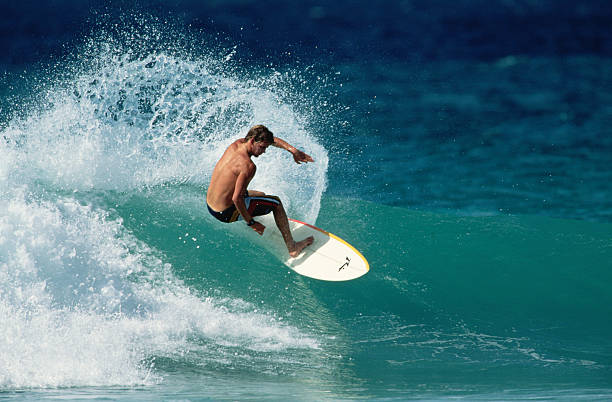
Tomson revolutionized tube riding by introducing a style of surfing that was low, aggressive, and forward. Where the old school approached a steep Pipeline wave with a high line, trying to stay above the curl, Tomson dropped in deep. He committed his rail to a radical bottom turn that didn’t just set his line, it fired him into the vortex. He wasn’t trying to skim the lip and stall back in; he was going in, hard and fast, with his back hand dragging in the green water to slow himself down and his front hand reaching for the face, almost touching the spit. That hand drag, that signature move, it wasn’t just a look. It was a throttle and a brake all at once. It gave him control in a place where control didn’t feel possible.
The wave that made him immortal, the one that rewrote the book for an entire generation, was the 1975 Pipeline Masters. Everybody remembers the final. Or at least they remember the product. Tomson faced Barry Kanaiaupuni in what is still considered the most important heat in the history of competitive surfing. But it wasn’t just the win that mattered. It was the way he did it. He stroked into waves that other men were paddling away from. He took off so deep you’d swear he was going to get swallowed whole by the reef. And then he didn’t just make the barrel. He drove through it, sometimes with his head down, sometimes with his eyes locked on the exit, and he came flying out the other end in a low, powerful crouch that looked like pure physics in motion.
That win did more than get him a trophy. It shattered the mental barrier at Pipeline. Before Tomson, there were surfers who could ride the wave, but he was the first to treat it like a tunnel to be conquered. He showed the world that the barrel wasn’t a place you got caught. It was a place you went on purpose. He pioneered the deep tube ride as a performance move, as the ultimate scoring maneuver. Every surfer who has ever pulled in at Pipeline since that day owes a bit of their stoke to the line he drew in the sand that winter.
His legacy is more than just the results. It’s in the feel of the wave. He surfed with a kind of calculated aggression that matched the raw energy of the ocean. He wasn’t flowy like a Gerry Lopez, who made it look like a dance. Tomson made it look like a mission. He was all power and purpose, with his tongue out, driving his board through the bowels of the wave. That style, that low-angled, rail-to-rail charge, became the blueprint for the modern power surfer. You see it in guys like Kelly Slater, who talked about watching film of Tomson to understand how to set a line in a heavy barrel.
Later in life, Tomson channeled that same focused energy into writing and speaking, sharing the mental side of the sport. He talked about the “wave of the day,“ that moment of clarity and courage that every surfer has to choose to take. That’s the philosophy he lived by. He didn’t just pioneer the technique of tube riding; he pioneered the mindset. He showed us that the most radical thing you can do in the ocean is not to fight the wave, but to trust it, to go where it wants to take you, and to have the guts to stay committed all the way through. That’s the lesson that keeps his spirit alive every time a surfer looks over their shoulder, sees the barrel forming, and drops in.