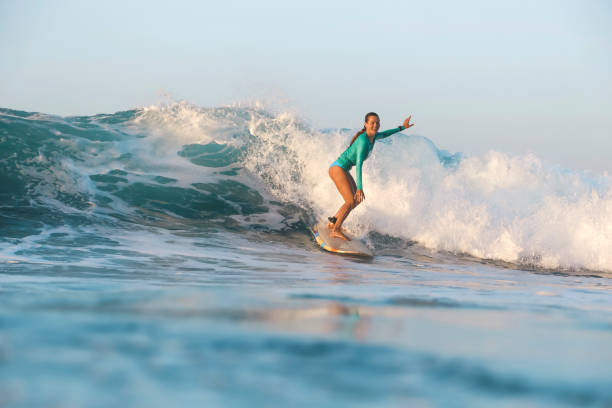
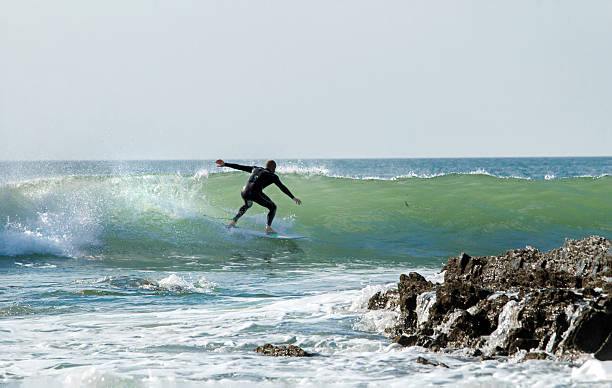
When you paddle out at dawn and the ocean lays down a clean line of swell, there is one shape that makes every surfer’s heart beat a little faster: the A-Frame. This wave is the holy grail of the lineup, the symmetrical peak that peels both left and right off a central apex like a roofline meeting in the middle. It is not the biggest wave out there, nor the most dramatic, but it is the most democratic. An A-Frame gives you options. It lets you choose your direction, commit to your line, and ride the kind of face that makes you feel like you actually know what you’re doing.
To understand the A-Frame, you have to understand how a wave builds. The ocean floor shapes the energy beneath the surface. When a swell rolls in over a reef, a sandbar, or a point break, the bottom contour bends the wave’s energy toward a focal point. If that point is perfectly centered under the peak, the wave will pitch up equally on both sides. That is the A-Frame. It is nature’s way of creating a perfect launch ramp. Unlike a closeout that detonates all at once, or a mushy wave that folds over with no real shoulder to work with, the A-Frame has a defined pocket, a clean face, and a forgiving angle that lets you slide into the barrel or carve a long, sweeping cutback.
The magic of the A-Frame lies in its symmetry. When you drop in on the face, the wave seems to open like a book. Your left and your right are both pristine. You can go forehand or backhand, depending on your stance and your mood. The peak holds its shape long enough for you to set your rail and feel the water stack beneath you. There is a certain zen to it, a moment when the wave and the surfer share the same geometry. The best A-Frames come from a long-period groundswell with clean, consistent energy. They do not like wind chop or cross-swell interference. They want glassy mornings or light offshore breezes that hold the face up.
For the intermediate surfer, the A-Frame is a teacher. It rewards a good bottom turn because the wave’s shoulder is arranged neatly in front of you. You will find that you can practice your top turns, your floaters, and even your tube riding if the wave is hollow enough. The A-Frame will not punish a late drop as harshly as a steep slab will. It gives you a second to adjust your feet, grab your rail, and commit. It is forgiving but not lazy. It still demands respect and timing.
On the epic end of the spectrum, the A-Frame can produce world-class barrels. Think of a reef pass like Teahupo’o or a perfect sandbar on a south swell. The wave pitches up so steeply that the A-Frame becomes a thick round cylinder. But even at a mellow beach break, the A-Frame is the wave you want when you are trying to improve your flow. It is the wave that connects your bottom turn to your top turn without a flat section in between. It is the wave that makes you feel like you are dancing, not just sliding.
The A-Frame also carries a deep lesson about the ocean itself. Waves are not random. They are the result of wind, fetch, bathymetry, and tide working together. When you paddle out and see that perfect peak, you are witnessing a coincidence of factors that might not repeat for hours or days. That is why surfers paddle hard for an A-Frame. They know that the window is brief. The drop, the carve, the glide, the exit. It is a conversation between you and the moving water, and the A-Frame speaks a language of balance and proportion.
So next time you sit in the lineup and a set rolls in with a clean peak that breaks both ways, do not hesitate. Stroke hard, pop up, and feel the wave open beneath you. That right there is the A-Frame, the wave that never judges, only offers. It is the reason we paddle out when the swell is small and the wind is wrong. It is the shape we dream about when we are stuck on land. It is the purest expression of what surfing can be: a moment of perfect alignment between the surfer, the wave, and the eternal rhythm of the sea.