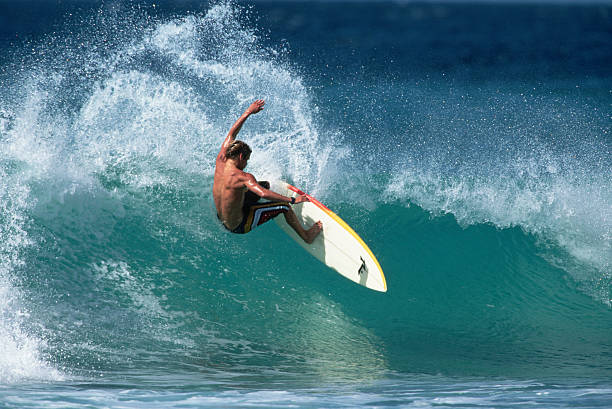
You paddle out on a clean morning, the horizon line sharp as a razor, and you see it—a peak that stands up like a tent pitched by Poseidon himself. Both shoulders pitch at the same steep angle, offering a left and a right that peel off in perfect symmetry. That, my friend, is the A-Frame. It is the wave that sits right at the heart of the spectrum between mushy and epic. It ain’t the slab of Pipeline or the freight-train wall of Jaws, but it is the wave every surfer dreams about when they close their eyes after a long day of groveling on ankle-biters. It is the great equalizer, the wave that rewards good positioning with the ride of your life.
The A-Frame gets its name from the shape it draws against the sky. When a swell hits a reef, a sandbar, or a point break at just the right angle, the wave peaks at a single apex. The energy of the swell focuses in on one point, pushing the water up into a steep, triangular peak. From the side, it looks like the letter A, a perfect triangle of water where both the left and the right break cleanly away from the center. That apex is the takeoff zone, the sweet spot where you want to sit. You don’t want to be too far inside, where the wave is already sectioning, and you don’t want to be too far outside, where you miss the steep part of the drop. You want to be right in the eye of the needle.
What makes the A-Frame so special is the promise of a ride in either direction. You paddle for the peak, pop up, and you have a split second—a heartbeat—to decide. Do you go left, where the shoulder looks a little softer but offers a longer wall? Do you go right, where the lip throws a little more vertical but the barrel might be shorter? That decision is yours and yours alone. It is the purest form of surfing freedom. You are not forced into a line by the bathymetry of the ocean. You are an athlete at a crossroads, reading the face of the wave and choosing your own adventure.
Now, the quality of the A-Frame varies based on the swell direction, the tide, and the bottom contour. A good A-Frame on a sandbar is a fickle creature. A shifting sandbar might give you a perfect left but a crumbling right. A reef pass, though, like the legendary ones in the Mentawais or the Maldives, can serve up A-Frames that hold their shape for hundreds of yards. Those waves are the kind that make you forget about your day job. They are the reason you pack a board bag and chase the lines on a weather chart halfway around the world.
Riding an A-Frame takes a certain kind of reading of the ocean. You have to watch the sets come through. Watch the horizon for a lump that looks a little darker, a little more defined. You paddle hard for the peak, not just to the shoulder. You need to get your board up on the face while the wave is still lifting you. If you are late, you get caught in the wash of the peak and get pitched over the falls in a brutal closeout. If you are early, you slide down the face before it has any power, losing all your momentum in a flat-bottomed slide. Timing is everything.
But when you nail it, when you take that drop on an A-Frame, it is a feeling of flight. The board releases, your center of gravity drops, and you are racing down a wall of water that is standing up like a green cliff. You bottom turn, feel the fins hook in, and you are off. You can carve off the top, throw a spray, or tuck into the tube if the wave is hollow enough. The A-Frame is the most democratic of waves. It doesn’t care if you are a shortboarder, a fish rider, or a longboarder. It will give you a wave. The longboarder might take the mellow shoulder while the shortboarder drops in steep. Everyone finds their own line.
In your surfing journey, the A-Frame is the benchmark. You start on mushy whitewater, then you catch unbroken waves on a soft beach break, and then you start hunting for the peak. The first time you successfully read an A-Frame and take the drop on the correct side, you cross a threshold. You stop being a beginner and become a surfer. You learn that the ocean is not just a flat plain of moving water. It is a sculpture in motion, and the A-Frame is its most beautiful, balanced form.
So next time you paddle out and see that peak rising up, pointing toward the sky like a prayer, don’t hesitate. Stroke hard, pop up with confidence, and commit. The wave will tell you where to go. You just have to listen.