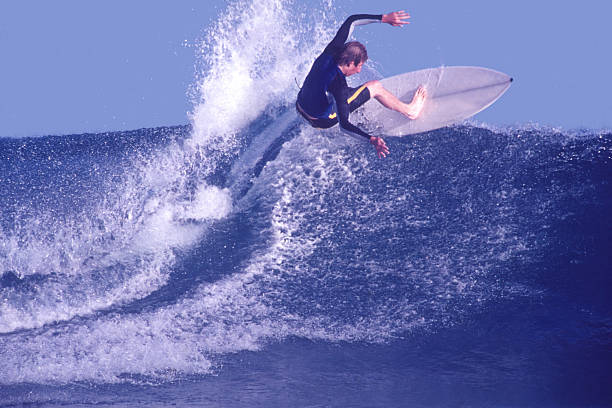
When you paddle out at Pipeline on a solid northwest swell, when the sets are marching in and the lip is throwing so far you can hear the hollow thump of the spit before you even see the wave, you’re chasing a dream that Shaun Tomson helped shape for all of us. Before Tomson came along, tube riding was a raw, unpredictable affair—guys would get lucky and stick a deep one now and then, but nobody had really figured out how to make the barrel a dance floor. Tomson changed that. He brought a South African cool, a scientific precision, and a pure, stoked love for the hollow wave that turned tube riding from a survival game into an art form.
Tomson grew up surfing the beach breaks of Durban, where the waves weren’t always perfect, but they taught him to read water, to feel the shift in the reef, to understand that every barrel is a living thing with a heartbeat. That background gave him a unique patience. While other surfers of the early 1970s were charging down the line and trying to outrun the foam ball, Tomson started hanging back, letting the wave swallow him, then using the wall to carve a clean, controlled arc through the deepest part of the barrel. He wasn’t just surviving the tube—he was living in it.
The moment that sealed his legend came in 1975 at the Smirnoff Pro, the de facto world championship event at Pipeline. On a day when the North Shore was pumping, Tomson paddled into a bomb. The wave jacked up, the lip threw over his head, and he dropped into a barrel so deep that the rest of the pack on the beach thought he was gone. But Tomson stayed low, his eyes locked on the exit, his board angled just enough to maintain speed without slipping into the wall. He came flying out into the channel, arms raised, and that ride—captured in the classic surf film “Free Ride”—became the benchmark for modern tube riding. People started calling it “the tube ride that invented the tube ride.” That wasn’t just hype. Before Tomson, nobody had ridden a barrel with that kind of control, that kind of style, that kind of consciousness.
What made Tomson stand out wasn’t just his courage. It was his technique. He pioneered the idea of staying high on the wave face as it jacks, then dropping into the barrel with a clean, late takeoff that let him disappear completely. He developed the “Tomson turn,” a hard bottom turn that set him up on the inside of the wave, where the tube was hollowest. And he understood that the exit was everything—you don’t just get pitted; you plan your way out of the spit like a surfer navigating a cave with a flashlight that’s about to go out. He used a shorter, more maneuverable board than his peers, a 6’2″ thruster-style design that let him whip through sections that would have pinned older, longer logs.
But Tomson’s influence goes deeper than one ride or one turn. He brought a mindset to tube riding that was about freedom, not fear. He talked about the barrel as a “holy place,” a quiet moment inside the chaos where the surfer and the ocean become one. That philosophy echoed through the next generation—guys like Gerry Lopez, Tom Carroll, and Kelly Slater all cite Tomson as a master of the barrel. Lopez, the “Mr. Pipeline” himself, once said that Tomson showed everyone how to ride the tube with style instead of just survival. And when you watch old footage of Tomson at Pipeline, you see it—the way his board seems to hum inside the wave, the way he stays so relaxed that you half-expect him to smile and wave to the crowd while still in the barrel.
Beyond his competitive wins—he was world champion in 1977, won two Pipeline Masters, and dominated the Smirnoff events—Tomson’s legacy is the way he democratized the tube. He proved that barrel riding wasn’t just for the psychos or the kamikazes. It was for anyone willing to learn the geometry of the wave, to practice the angle, to trust the exit. He wrote books, made films, and coached young surfers, always bringing that same easygoing stoke he had as a grom in Durban.
So next time you drop into a hollow wave, when the water goes dark and you feel that quiet hum, remember Shaun Tomson. He didn’t just pioneer tube riding. He showed us the way inside, taught us to find the light at the other end, and made sure the barrel would always be the ultimate canvas for the surfer’s soul.