There’s a certain magic that happens when a surfer drops into a heaving Pipeline wave and disappears behind a curtain of crystal-blue water. Before Shaun Tomson came along, that magic was mostly a right-hander’s game—barrels were for goofyfoots dropping in frontside, or for the occasional lucky left-footer who managed to squeak through. But Tomson, a natural-foot from Durban, South Africa, changed everything. He didn’t just surf Pipeline backside; he owned it. He made the backside barrel an art form, a dance of commitment, timing, and sheer audacity that rewrote the rulebook of tube riding. And in doing so, he became one of the most influential surf icons of the 1970s, a pioneer whose legacy still ripples through every barrel session today.
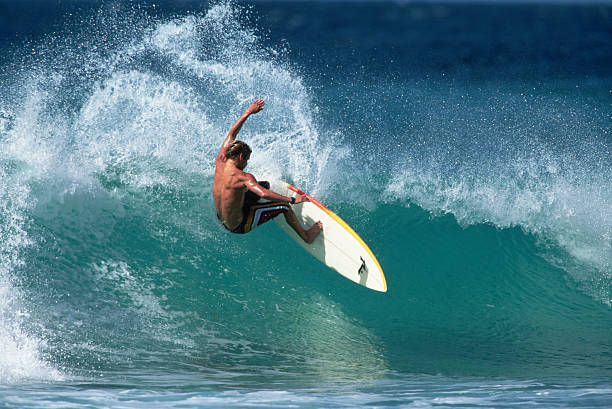
Tomson’s approach to Pipeline was unlike anything the surfing world had seen. Most backside surfers struggled to generate speed on a wave that jacks up so fast and throws such a shallow, pitching lip. They’d get swallowed, pitched over the falls, or stuck in the closeout section. But Tomson found a way to slide into the barrel with a low, crouched stance, his back hand skimming the wall while his front foot drove off the bottom. He read the wave’s pulse like a drummer reading a break—anticipating the moment when the tube would stretch out, open up, and let him stall just enough to stay in the green room without getting mowed. His famous 1978 ride at Pipeline, captured in the film “Free Ride,” is still studied frame by frame. He drops in late, takes two hard pumps, and then just… waits. The wave wraps around him, a perfect cylindrical chamber, and he emerges with a calm smile, as if he’d planned the whole thing over a morning coffee.
But Tomson’s impact goes beyond that one wave. He brought a South African soul to Hawaiian heavy water, a laid-back yet fiercely focused energy that mixed the technical precision of his peers (like Michael Peterson) with a showman’s flair. He wasn’t just surviving Pipeline; he was styling on it. His signature move—the bottom turn that flowed into a drawn-out barrel ride, followed by a delicate fade into the channel—became the template for every aspiring tuberider who wanted to ride a left-breaking reef with their back to the wave. Before Tomson, backside barreling was a survival tactic. After him, it was a statement of mastery.
Tomson’s technique was rooted in a deep understanding of wave dynamics. He’d paddle into waves later than most, trusting his ability to generate speed through compression and extension. His backside barrel stance was all about keeping the weight centered, the knees bent, and the eyes fixed on the exit point—not the lip, not the foam ball, but the light at the end of the tunnel. He once described it as “falling into the wave and letting the wave hold you up.” That zen-like mindset, combined with a surfer’s instinct for positioning, allowed him to ride waves that would spit out lesser men into the coral gardens of Ehukai Beach.
Beyond the physical, Tomson’s legacy is a mental one. He wrote “Surfer’s Code,” a book that distills the lessons he learned from decades in the water. His 12 principles—things like “be humble,” “choose your wave,” “go with the flow”—are just as relevant to a grom learning to paddle out at Soup Bowls as they are to a world-tour contender charging Teahupo‘o. Tomson understood that tube riding, especially backside at a wave like Pipeline, is a meditation on fear and patience. You can’t force a barrel; you have to let it happen. That philosophy, born in the deep pits of the North Shore, has seeped into surf culture worldwide.
Today, when you see guys like John John Florence or Mikey Wright pulling into backside barrels at Pipeline, you’re watching Shaun Tomson’s ghost steering their boards. They may have modern equipment—thrusters, carbon fins, lighter foam—but the foundational moves are pure Tomson. He showed that backside didn’t have to be awkward. It could be beautiful. It could be the best ride of your life.
So next time you’re staring down a pitching left, feeling that flutter in your gut, remember the South African kid who turned the backside barrel into an art. Drop your weight, stall, and trust the wave. Because as Shaun Tomson would tell you, the best wave isn’t the one you survive—it’s the one that holds you in its center, wraps around you like an old friend, and spits you out grinning.