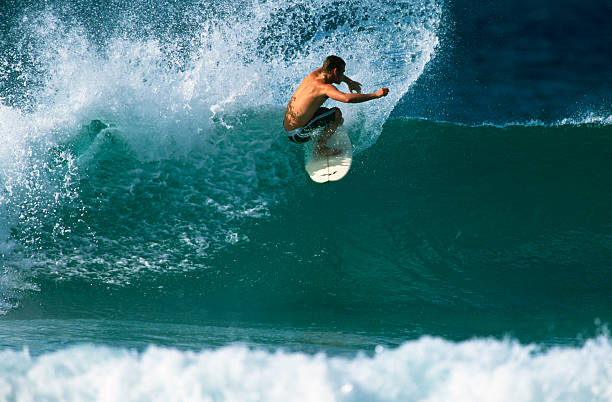
There’s a moment every surfer chases. The weight of the ocean pushes down on your back, the lip hisses past your ears, and suddenly the world folds into a liquid tunnel of electric blue. That’s the green room. And nobody, not even the gnarliest of modern air-reversers, owns that space like Shaun Tomson did back in the day. When we talk about pioneers of tube riding, we’re not just talking about someone who got lucky a few times. We’re talking about a guy who turned the barrel into a canvas, a dude who took the most dangerous, most unpredictable part of a wave and made it look like pure poetry on a twin fin.
Before Tomson came along, tube riding was mostly a south swell afterthought. Guys would get barreled by accident, kick out sideways while praying to the surf gods, or just claim a close call. But Shaun? He showed up at the North Shore with a shortboard, a radical approach, and a willingness to go deeper than anyone had gone before. This was the early seventies. Boards were still transitioning from long to short, and the idea of pulling into a heaving, hollow wave like Pipeline was straight-up kamikaze territory. Tomson didn’t just survive it. He mastered it, line by impossible line. He invented a style that was so fluid, so critically timed, that it redefined what a surfer could do in the thick of the whitewater. His backhand barrel at Pipeline is still the gold standard, the reference point every goofyfooter dreams about. He didn’t bully the wave. He negotiated with it, sliding up near the foamball, wrapping his body around the curve, and letting the force of the exit just spit him out like a seed from a watermelon.
What made Shaun different wasn’t raw power or brute strength. It was precision. He had this insane ability to read the secondary swell, the little bump that would either open up the tube or shut it down like a door slamming. While others were scratching over the falls, he was already committed to the deepest part of the pit, carving a high line so tight that his shoulder practically touched the reef. His board control was telepathic. He could stall, tuck, and then pump for speed in sections that looked unmakeable. That famous backside snap, the one where he’d throw his whole upper body into a pivot off the foam ball—that wasn’t just a maneuver. It was a statement. It told every young grom in Hawaii and California that the barrel wasn’t something you survived. It was something you rode, with flow and finesse, like a jazz musician riding the rhythm of the sea.
But Tomson’s pioneer spirit didn’t stop at technique. He also helped turn the survival of the fittest mentality into an art form. In his prime, he was charging Sunset Beach and Waimea too, but his heart lived in the hollow sections. He brought the idea of the “critical” tube ride to the world—not just getting inside the wave, but getting so deep that the exit requires a late drop and a full commitment to the revolving mass of water. He pushed equipment too, working with shapers to develop fins and templates that allowed for tighter rails and more pivot. The modern shortboard’s ability to handle steep, barreling waves owes a massive debt to his experimentation.
Beyond the physical, Shaun gave the surfing culture a different kind of energy. He wasn’t the aggressive, territorial alpha that plagued the North Shore back then. He was smooth, articulate, almost zen-like in his approach. He talked about the barrel as a sacred place, a moment of calm inside the chaos. That perspective changed how surfers viewed heavy waves. Instead of just a battle, the tube became a sanctuary. His book, Surfer’s Code, carried that vibe to millions of landlocked dreamers. He reminded us that the ocean is a teacher, and the deepest barrel is the deepest classroom.
Today, you see kids pulling into cavernous slabs on jetskis, getting towed into sixty-foot mutants, and doing huge air reverses out of pits. They owe Shaun a nod. Not because he’s the biggest, not because he’s the strongest, but because he showed that intelligence and style could outrun fear. When the swell pumps and the lineup clears, and that one perfect wave lines up, the mental image is still Shaun, tucked low, right arm dragging, left arm reaching toward the light as the monster spits him out clean. That’s the legacy of a true pioneer. That’s the green room in its purest form.