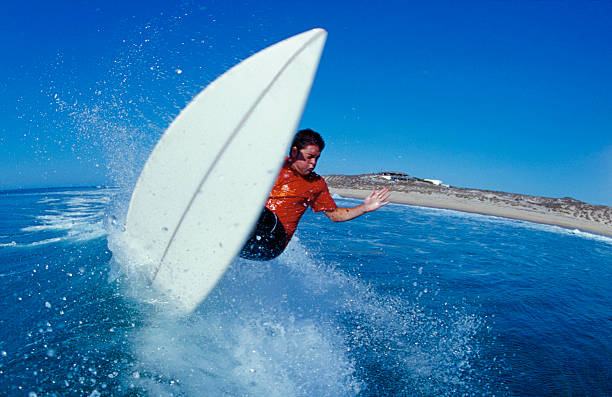
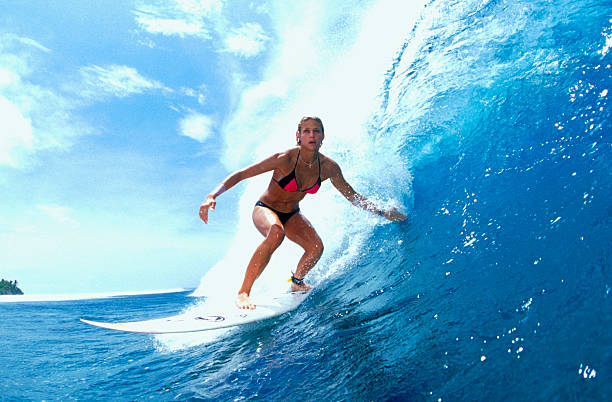
Out there on the salt, every wave you paddle for is a story being written by the ocean floor. And if you really want to get dialed in, you gotta understand the stage that wave is dancing on. We talk about the lineup, the takeoff, the shoulder, but none of that matters if you don’t know what’s going on beneath your board. In the endless pursuit of that perfect session, you’ll run into three main types of breaks: beach, point, and reef. Each one has its own personality, its own heart, and its own set of rules. Getting to know them is like learning the language the ocean is already speaking to you.
A beach break is the most democratic wave on the planet. It’s where most of us learned to pop up and where the vibe is often the most laid back because the waves are as unpredictable as a summer squall. The sand shifts constantly, pushed around by swell direction, tides, and winter storms, so the takeoff zone can change from one day to the next. One morning you might find a perfect, hollow peak peeling off a sandbar that wasn’t even there last week. The next day, that same spot is a fat, mushy burger that closes out on you before you even get to your feet. Beach breaks are fickle, but they reward the surfer who pays attention. You gotta watch for the darker water that indicates a deeper channel, and the white, foamy soup that marks a shallow sandbar. The rip currents here aren’t your enemy; they are your free ride out the back. The beauty of a beach break is that anyone can find a wave, from a grom on a foamie to a pro charging a double-overhead set. It’s a raw, honest playground where the ocean doesn’t hold back her secrets, she just changes them on a whim.
Then you have the point break, the smooth operator of the surf world. This is where a wave wraps around a headland or a rocky point, peeling perfectly in one direction for what feels like eternity. The bottom is usually rock, cobblestone, or a hard-packed sand shelf, so the wave shape is consistent and predictable. If a beach break is a wild horse, a point break is a well-trained thoroughbred. The takeoff is often mellow compared to the barrel you might get, but the ride is long and lined up, allowing you to draw out those turns and connect sections that would be separate at a beach break. You can get a rhythm here, a flow state that feels meditative. The locals at a point break often have a deep, almost spiritual respect for the wave because they know its moods and its magic. But with that consistency comes a certain code of conduct. There is a hierarchy in the lineup, a silent understanding of who drops in on whom and where the priority sits. You don’t just paddle out at a point break and snake the first wave you see. You earn it by watching, by respecting the queue, and by understanding that the wave belongs to everyone for a moment, then to you for a ride.
And finally, there is the reef break, the heavy hitter. This is where the ocean really flexes its muscle. A reef break happens when a swell moves over a submerged coral, rock, or lava formation. The result is a wave that jacks up fast, hollow, and often powerful, breaking in a shallow, unforgiving zone. These are the waves that make your heart pound in your throat. They can be perfect, A-frame peaks that barrel like a freight train, but the consequence of a wipeout is real. You’re not just taking a tumble over soft sand; you’re navigating a shallow ledge covered in marine life. Reef cuts are a badge of honor, and the locals who charge these waves have a deep, almost primal connection to that stretch of coast. The wave here is less forgiving, but it offers a purity you can’t find anywhere else. When you drop into a reef break, you are committing your entire body to a single, perfect moment. There is no second-guessing. The wave demands your full attention and respect. A good reef break will only break on a specific swell direction and tide, so you have to be patient and read the charts. But when it lines up, there is no better feeling in the world than sliding down a steep, emerald wall with the reef below you as a constant, thrilling reminder that you are alive.
So whether you are chasing the shifting sands of a beach break, the long, lined-up dance of a point, or the heavy, hollow power of a reef, know that each one is a different conversation with the ocean. Listen to the bottom, feel the pulse of the swell, and always, always keep your eyes on the horizon.